
What is the tablet manufacturing process?
The tablet manufacturing process turns a powder formula into a firm, uniform tablet in a set order. Ingredients are milled to a similar particle size, blended evenly, often formed into small granules, pressed into shape, and sometimes coated, with quality checks at every stage.
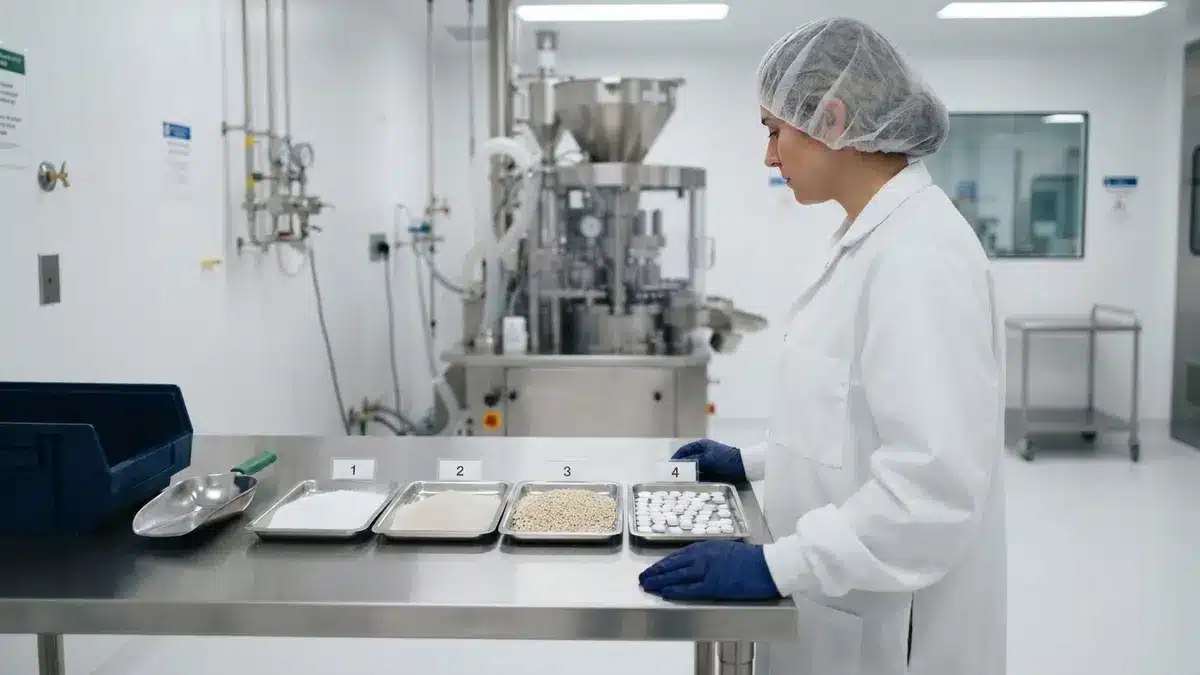
Each step shapes the finished product. It decides how the tablet looks, how big it is, how well it holds together in the bottle, and whether every tablet carries the same amount of each ingredient as the label states.
If you are planning a tablet SKU, you do not need to run a press yourself. But knowing what happens at each stage helps you ask better questions, set realistic expectations and avoid costly changes late in development. This guide walks through each step from a brand owner’s point of view.
Tablet manufacturing process step by step: the full overview
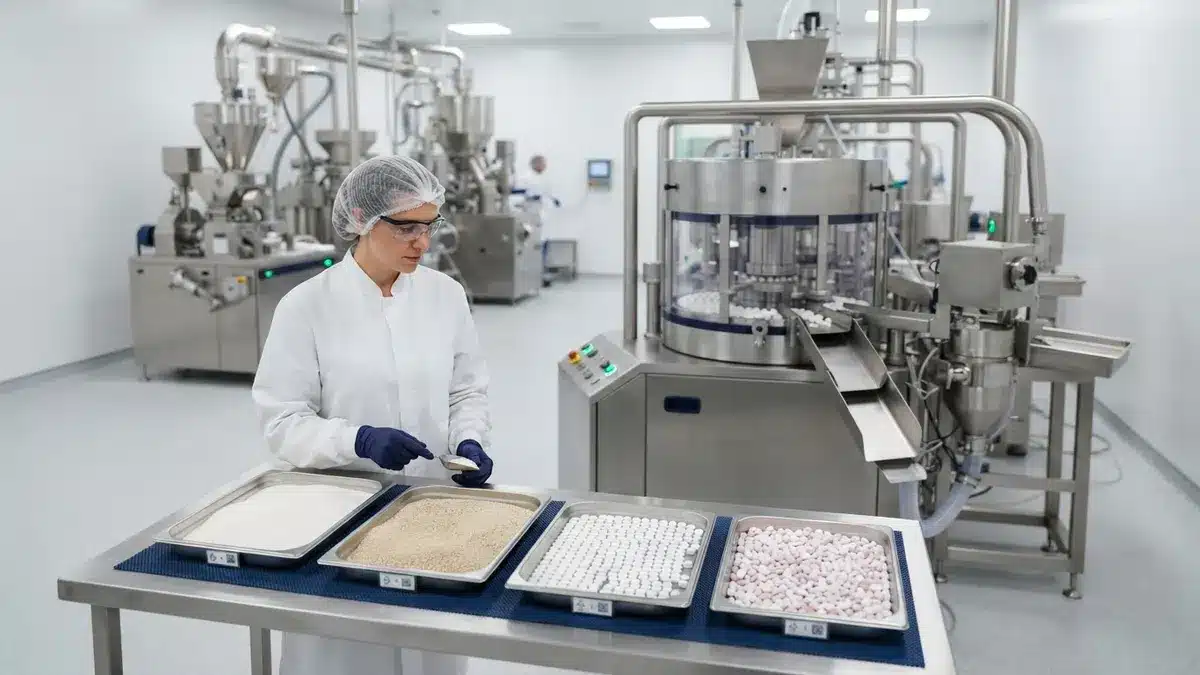
Here is the whole journey at a glance. The sections below go into each step in more detail.
| Step | What happens | What it means for your product |
|---|---|---|
| Ingredient check | Raw materials are received, identified and tested against their specifications. | The right ingredients, at the right strength, go into your batch. |
| Milling | Ingredients are ground or screened to a similar particle size. | Smoother mixing, better flow and more even tablet weights. |
| Blending | Actives and supporting ingredients are mixed into one even blend. | Every tablet carries the same dose. |
| Granulation | The blend is formed into small granules (wet or dry method). | Better flow and binding for powders that will not press well on their own. |
| Drying | Wet granules are dried and sized. | Stable granules that press cleanly and keep well. |
| Compression | A tablet press squeezes the mix into its final shape. | Size, shape, hardness, thickness and any logo or score line. |
| Coating | A thin outer layer is sprayed onto the tablets. | Easier swallowing, masked taste or smell, protection and a finished look. |
| Inspection | Tablets are checked for weight, hardness, break-down and ingredient content. | Confidence that the batch matches the label and holds up in transit. |
| Packaging | Tablets are filled into bottles or other packs and sealed. | Protection from moisture and air through the product’s shelf life. |
Why does the order matter?
Every step depends on the one before it. If the blend is uneven, no amount of careful pressing or coating will fix it. If particle sizes vary widely, the press will struggle to fill each tablet the same way. A problem that starts early travels all the way to the bottle.
That is why quality is built into the process, not added at the end. Final testing confirms what good process control has already produced. It cannot rescue a batch that went wrong in milling or blending.
Does every tablet go through every step?
No. The formula decides. A simple formula that flows and binds well may skip granulation and drying entirely. A tablet with a mild taste and stable ingredients may not need a coating. Your manufacturer’s job is to choose the shortest path that still produces a consistent, stable tablet.
What is milling in tablet manufacturing?
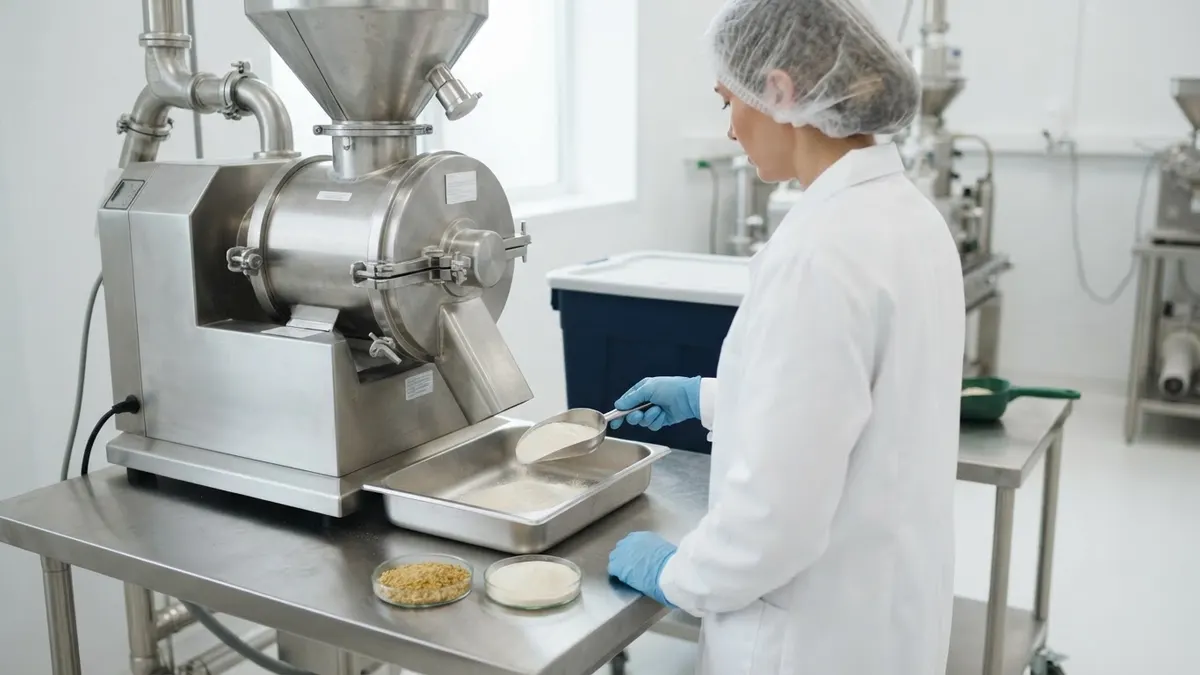
Milling is the step where ingredients are ground or screened so their particles are a similar size. Think of it as getting every ingredient onto the same footing before they are mixed.
Why does particle size matter?
- Even mixing. Particles of a similar size mix together more evenly. Large and small particles tend to separate, much like nuts rising to the top of a bag of trail mix.
- Better flow. A press fills each tablet cavity by letting powder flow in. Consistent particles flow more predictably, so each tablet gets about the same amount of material.
- Consistent weight. When fill is consistent, tablet weight is consistent. When weight is consistent, the dose per tablet is consistent.
What goes wrong when particle sizes vary?
Three problems show up most often. Ingredients separate after blending. Tablets come out with uneven amounts of the active ingredients. Or the surface looks speckled, because coarse colored particles stand out against a fine base.
Herbal extracts and minerals often need extra attention here. Plant material can be fibrous and uneven. Some minerals are dense or gritty. Both can behave very differently from the rest of the formula until they are sized properly.
What is blending in tablet manufacturing and why does it matter?
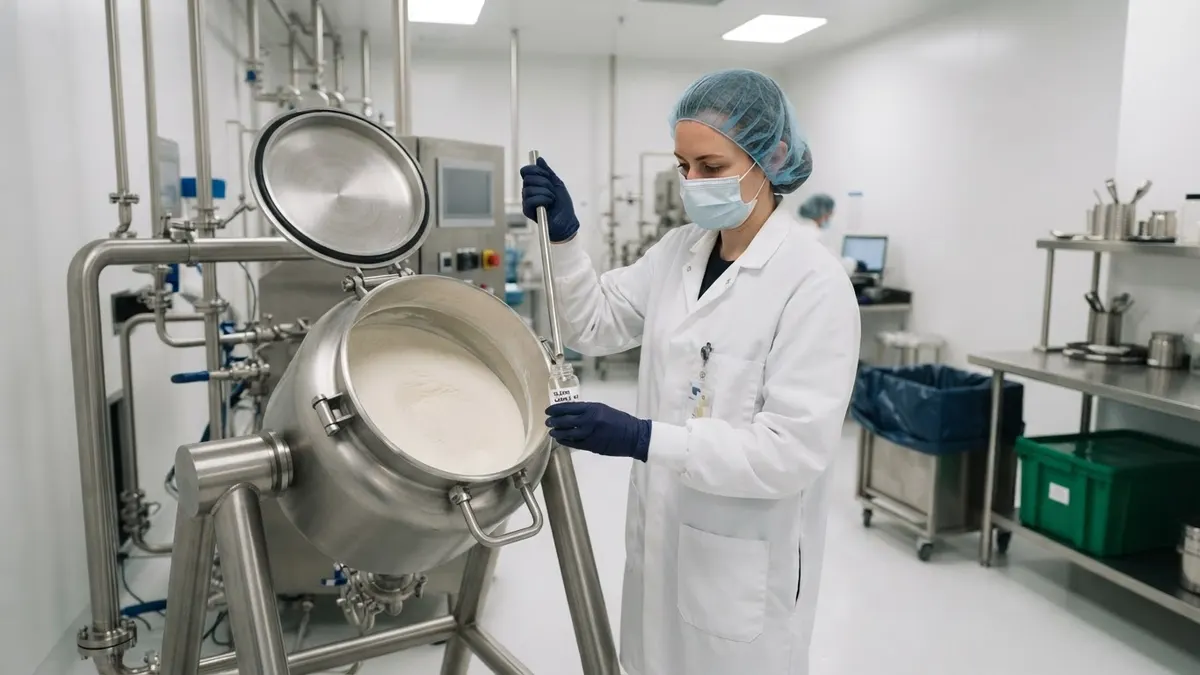
Blending is the step where all the active ingredients are mixed with the supporting ingredients into one even blend. Supporting ingredients usually include:
- Fillers that add bulk, so a small-dose ingredient can be pressed into a tablet of a practical size.
- Binders that help the tablet hold together after pressing.
- Flow aids and lubricants that help the powder move through the equipment and release cleanly from the press.
Blending is the step that protects consistency. Your label promises a set amount of each ingredient per serving. The only way every tablet delivers that amount is if the blend is even before a single tablet is pressed.
What makes blending difficult?
- Very small-amount ingredients. Some vitamins are used in tiny amounts per serving. Spreading a small quantity evenly through a large batch takes care, and often a step-by-step approach where the small ingredient is pre-mixed with part of the batch first.
- Mixes that separate after blending. A blend can be even in the mixer and then separate as it is moved, stored or fed into the press. Differences in particle size and density are the usual cause, which is why milling and blending go hand in hand.
- Over-blending. More mixing is not always better. Some lubricants, if blended too long, can weaken tablets or slow how quickly they break down.
How do manufacturers check that a blend is even?
A careful manufacturer takes samples from different points in the blend and tests them before moving on. If the samples agree, the blend is ready. If they do not, the issue is found and corrected while it can still be fixed, not after thousands of tablets are pressed. Tablet manufacturing under cGMP is built around documented steps like this, so the process can be repeated the same way on every run.
Tablet manufacturing methods: direct compression vs. wet and dry granulation
There are three main tablet manufacturing methods. They differ in how the blend is prepared before it reaches the press.
Direct compression
The blended powder is pressed straight into tablets. It has the fewest steps, which can mean a simpler and shorter process. The catch: it only works when the powder flows well and binds well on its own. Many formulas do not.
Wet granulation
A liquid is added to the blend to form small clumps called granules. These are dried and then sized. Granules flow and bind better than loose powder, so this method suits powders that will not hold together well. The trade-off is extra time for wetting and drying, and it is a poor fit for ingredients that are sensitive to moisture or heat.
Dry granulation
The powder is pressed into sheets or large slugs, which are then broken down into granules. It improves flow and binding without adding liquid or heat, which makes it useful for ingredients that do not tolerate moisture.
How do the methods compare?
| Method | When it is used | Number of steps | Effect on time | Suits |
|---|---|---|---|---|
| Direct compression | Powder already flows and binds well | Fewest | Usually shortest | Simple formulas with well-behaved ingredients |
| Wet granulation | Powder is fine, fluffy or will not hold together | Most (adds wetting, drying, sizing) | Longest, because of drying | Ingredients that tolerate moisture and heat |
| Dry granulation | Powder needs help but cannot get wet | Middle (adds pressing and breaking) | In between | Moisture- or heat-sensitive ingredients |
The formula, not preference, usually decides the method. A brand owner might prefer the shortest route, but if the powder will not press cleanly, forcing direct compression leads to weak tablets, uneven weights and wasted runs. A good manufacturer explains which method your formula needs and why.
What is compression in tablet manufacturing?
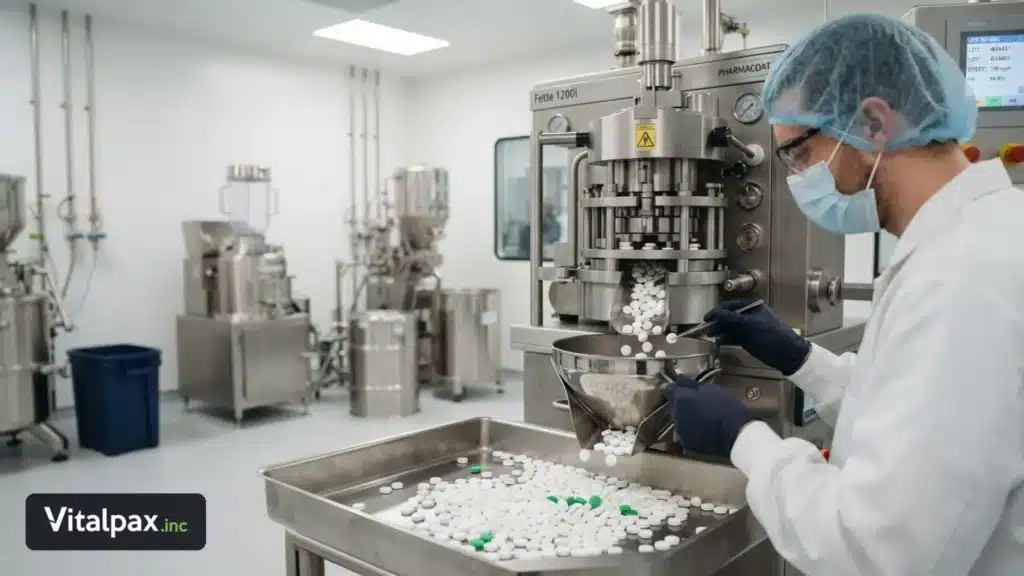
Compression is the step where a tablet press squeezes the prepared mix into its final shape. The powder or granules fill a cavity called a die, and two metal punches press together from above and below to form the tablet.
What does compression control?
- Size and shape. Round, oval, caplet or a custom shape, set by the tooling.
- Thickness. How deep the tablet is, which affects how it fits in the hand and in the bottle.
- Hardness. How firmly it holds together.
- Markings. Any logo, letters or score line pressed into the surface, also set by the tooling.
What is the balance in compression?
Pressure is a balancing act. Too little, and tablets chip, crumble or break apart in the bottle and in shipping. Too much, and they may become hard to swallow comfortably or slow to break down after they are taken. The right setting depends on the formula, and it is checked throughout the run.
How does dose affect tablet size?
This is where many brand owners get surprised. A tablet has to hold the active ingredients plus the supporting ingredients that let it press and hold together. A high-dose formula can quickly become a large tablet.
Work it through with your own numbers. Add up the total weight of the actives in one serving, then allow room for fillers, binders and flow aids. If the total makes a tablet bigger than your customers will want to swallow, you have two practical options: split the serving into two or more tablets, or rethink the dose. Both affect how customers feel about the product, so it is better to decide early than to find out at the first press run.
Why are some supplement tablets coated?
A coating is a thin outer layer sprayed onto tablets after pressing. Brands choose a coating for a few common reasons:
- Easier swallowing. A smooth coating helps a tablet slide down more easily.
- Taste and smell. It hides bitter or strong-smelling ingredients, which matters for many herbal and mineral formulas.
- Protection. It can help shield ingredients from moisture and air.
- Appearance. Color and a clean, uniform finish give the product a more polished look and hide natural speckling.
What are the trade-offs of coating?
Coating adds a step, time and cost. The coating material also has to fit your label claims. For example, if you plan to market the product as vegan or free from certain allergens, the coating ingredients need to meet that standard too.
Uncoated tablets can be a fine choice. If your formula has a mild taste, is stable, and presses into a smooth tablet of a comfortable size, skipping the coating may simplify the process without hurting the product.
Quality checks and common mistakes to avoid when launching a tablet
What checks are made during and after production?
- Weight, so each tablet carries the intended amount of material.
- Hardness and thickness, so tablets are firm and uniform.
- Durability, meaning how well tablets hold up to tumbling and handling without chipping or dusting.
- Break-down time, meaning how quickly the tablet comes apart once taken.
- Ingredient content, testing that the amounts match the label.
These checks are part of why certifications matter. As we explain in Proof of Quality: Why Certifications Count, certified processes rely on audits, traceability, testing standards and documentation across sourcing, formulation, blending, packaging and storage.
Checklist for brand owners before the first run
- A realistic dose per tablet, based on the total weight of your actives.
- Your preferred size and shape, and how many tablets per serving you can accept.
- Coated or uncoated, and why.
- Label claims (such as vegan or allergen-free) that limit ingredient and coating choices.
- Packaging that protects tablets from moisture, especially for sensitive ingredients.
Mistakes to avoid
- Packing too high a dose into one tablet. The result is a tablet that is hard to swallow or hard to press well.
- Choosing ingredients that do not press well without planning for it. Sticky, fluffy or oily ingredients may need a different method or supporting ingredients.
- Skipping stability planning. A tablet that looks right on day one still needs to hold up through its shelf life.
- Changing the formula late. A late change can mean new tooling, new testing and a reset timeline.
The details at the start matter. Early decisions shape cost, timeline, and how the tablet looks and feels in your customer’s hand.
How to plan your supplement tablet with a manufacturing partner
You do not need a finished formula to start the conversation. It helps to have a few things ready:
- Your formula or product idea, even if it is a rough list of ingredients.
- Your target dose per serving.
- How many tablets per serving you are willing to ask customers to take.
- Where you plan to sell, since some markets and channels bring their own requirements.
A partner with in-house R&D and formulation can help adjust a formula so it presses well, stays consistent and fits your label claims. That work is far easier before the first production run than after it.
Vitalpax is a U.S.-based, cGMP-compliant contract manufacturer on a multi-building manufacturing campus in Southern Utah. We make tablets alongside capsules, powders, sachets and stick packs, and liquids, and we work with 7,000+ unique ingredients a year. Our turnkey services cover in-house R&D and formulation, full-service manufacturing, packaging and private label, international shipping and certifications, and both large and small batches, so a single partner can take your tablet from concept to shelf.
Ready to talk through your tablet idea? Request a free quote from Vitalpax and tell us about your formula, your target dose and where you plan to sell.
Frequently asked questions
What are the steps in the tablet manufacturing process?
The usual steps are checking ingredients, milling, blending, granulation, drying, compression, coating, inspection and packaging. Not every tablet goes through every step; a formula that flows and binds well may skip granulation and drying, and some tablets are left uncoated. Quality checks run throughout, because a problem early on cannot be fixed at the end.
What is compression in tablet manufacturing?
Compression is the step where a tablet press squeezes the prepared powder or granules into their final shape between two metal punches inside a die. It sets the tablet’s size, shape, thickness, hardness and any logo or score line. Too little pressure gives crumbly tablets, while too much can make them hard to swallow or slow to break down.
What is blending in tablet manufacturing and why does it matter?
Blending mixes the active ingredients with supporting ingredients such as fillers, binders and flow aids into one even blend. It matters because every tablet should carry the same amount of each ingredient as the label states. Manufacturers sample the blend from different points and test it before pressing to confirm it is even.
What is milling in tablet manufacturing?
Milling is grinding or screening ingredients so their particles are a similar size. Similar-sized particles mix more evenly and flow more predictably into the press, which helps every tablet weigh the same. Uneven particle sizes can cause ingredients to separate, doses to vary or tablets to look speckled.
Why are some supplement tablets coated?
A thin coating can make tablets easier to swallow, hide bitter tastes or strong smells, help protect ingredients from moisture and air, and give a cleaner, colored finish. Coating adds a step, time and cost, and the coating material must fit the brand’s label claims. Uncoated tablets can be a fine choice for mild, stable formulas.
What are the main tablet manufacturing methods?
The three main methods are direct compression, wet granulation and dry granulation. Direct compression presses the blend straight into tablets and has the fewest steps, but only works when the powder flows and binds well. Wet granulation adds liquid to form granules that are then dried, while dry granulation presses powder into sheets or slugs and breaks them into granules without moisture.
What is tablet manufacturing, in simple terms?
Tablet manufacturing is the process of turning a powder formula into firm, uniform tablets. Ingredients are sized, mixed evenly, often formed into granules, pressed into shape and sometimes coated. The goal is a tablet that holds together and delivers the same dose every time.
Can a private label supplement manufacturer help me turn my formula into a tablet?
Yes. Vitalpax is a cGMP-compliant contract manufacturer in Southern Utah that makes tablets, and its turnkey services include in-house R&D and formulation, full service manufacturing, packaging and private label, and large and small batch capabilities. You can request a free quote to talk through your formula and target dose.