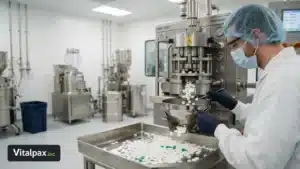


The capsule manufacturing process turns a written formula into sealed bottles in eight stages. Incoming ingredients are tested, weighed and blended, then machines fill the blend into capsule shells. The capsules are polished, inspected, bottled and labeled, and the finished product is checked again before it ships.
This guide walks through each stage as it runs on a production floor. It covers what your brand supplies at each point and where first-time launches most often lose time or money.
What is the capsule manufacturing process?
Capsule manufacturing means filling measured doses of a powder blend into two-piece hard shells, at scale, with the same result in every capsule. Most supplement brands hire a contract manufacturer to run it.
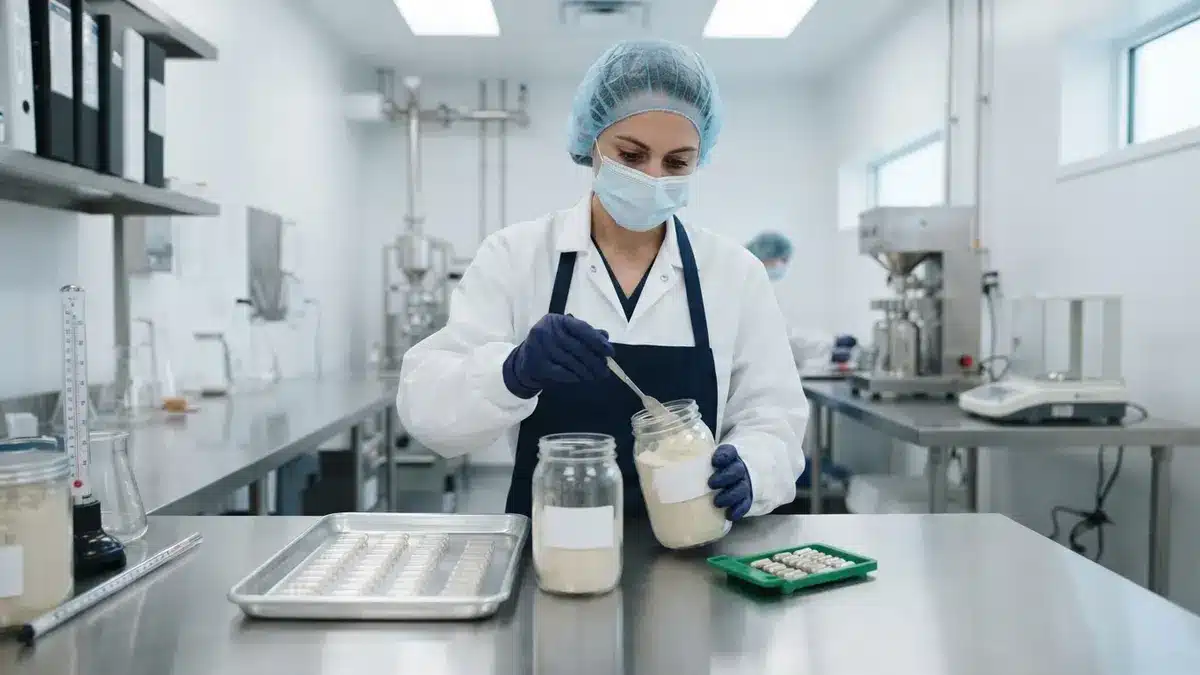
Every stage runs inside a plant that follows current Good Manufacturing Practices (cGMP). In plain words, cGMP means written rules for clean, consistent, traceable production. Each step has a procedure. Each batch has a record. Anyone reviewing that record should be able to see what went into the batch, who handled it and what the tests showed. For dietary supplements sold in the U.S., these rules sit in 21 CFR Part 111.
The roles are split clearly:
- The brand owns the formula, the label and the decisions about where and how to sell.
- The manufacturer owns the making: ingredient testing, production, packaging and the batch documentation.
A good partner also speaks up early when a formula or label is likely to cause trouble later. The details at the start matter.
Capsule manufacturing process flow chart: the 8 steps at a glance
Here is the full capsule production process as a simple flow chart:
Raw material testing → Weighing → Blending → Encapsulation → Polishing → Inspection → Bottling and labeling → Release testing
| Step | What happens | What your brand provides |
|---|---|---|
| 1. Raw material testing | Each incoming ingredient is held and checked for identity and quality before use | Ingredient choices and any special requirements, such as organic or a standardized extract |
| 2. Weighing | Each ingredient is measured to the master formula and recorded by lot number | A final, signed-off formula with the dose per serving |
| 3. Blending | Ingredients are mixed until even | Approval of any flow agents the blend needs |
| 4. Encapsulation | Machines open the shells, fill them with the blend and close them | Shell type, capsule size and capsules per serving |
| 5. Polishing | Loose powder is removed from the outside of each capsule | Nothing; this is the manufacturer’s step |
| 6. Inspection | Damaged or under-filled capsules are removed and weights are checked | Any appearance expectations, such as shell color |
| 7. Bottling and labeling | Capsules are counted, bottled, sealed, capped and labeled | Label artwork, packaging choice and count per bottle |
| 8. Release testing | The finished product is checked against its specification before it ships | Final sign-off, plus a request for the batch paperwork |
The order matters. A wrong ingredient caught at step 1 costs one returned drum. The same problem found at step 8 costs the whole batch, the shells, the bottles, the labels and weeks of delay to your launch date.
How capsules are made: from raw ingredients to filled capsules
Step 1: Raw material testing
Nothing goes into production until it is checked. Each ingredient arrives with a supplier certificate of analysis (COA), but a cGMP plant does not rely on paperwork alone. Material is held in quarantine and tested to confirm it is what the drum label says.
Vitalpax runs laboratory testing with High-Performance Liquid Chromatography (HPLC) and Fourier-Transform Infrared Spectroscopy (FTIR). In plain words:
- FTIR reads a chemical fingerprint of a sample. It answers the question: is this ingredient really what we ordered?
- HPLC separates a sample into its compounds and measures how much of each is present. That matters for extracts sold on a set amount of an active compound.
Vitalpax works with 7,000+ unique ingredients a year. Every one needs its own specification and identity check, so a wide ingredient library is only useful when testing keeps pace with it.
Step 2: Weighing
Each ingredient is weighed to the master formula and its lot number is written into the batch record. That record lets anyone trace a single bottle back to every ingredient lot used to make it.
Run the numbers for your own product. Say your label lists 300 mg of an ingredient per two-capsule serving, and the batch is 100,000 capsules. That is 50,000 servings, so the batch needs 15 kg of that ingredient, plus any overage your formulator sets for ingredients that lose strength over shelf life.
Step 3: Blending
Blending has one job: every capsule gets the same amount of every ingredient. Ingredients used in tiny doses, such as a vitamin measured in micrograms, are often pre-mixed with a small portion of a larger ingredient first. That spreads them evenly through the full batch.
The blend also has to run well on the machine. Two properties decide that:
- Density. Light, fluffy powders take up more room. They may need a bigger capsule or more capsules per serving.
- Flow. Sticky or clumping powders do not feed evenly into the filling machine, which causes uneven fills.
Small amounts of flow agents fix many of these issues. If you want a label with no flow agents, raise it during formulation. It can change the capsule size or slow the run.
Step 4: Encapsulation
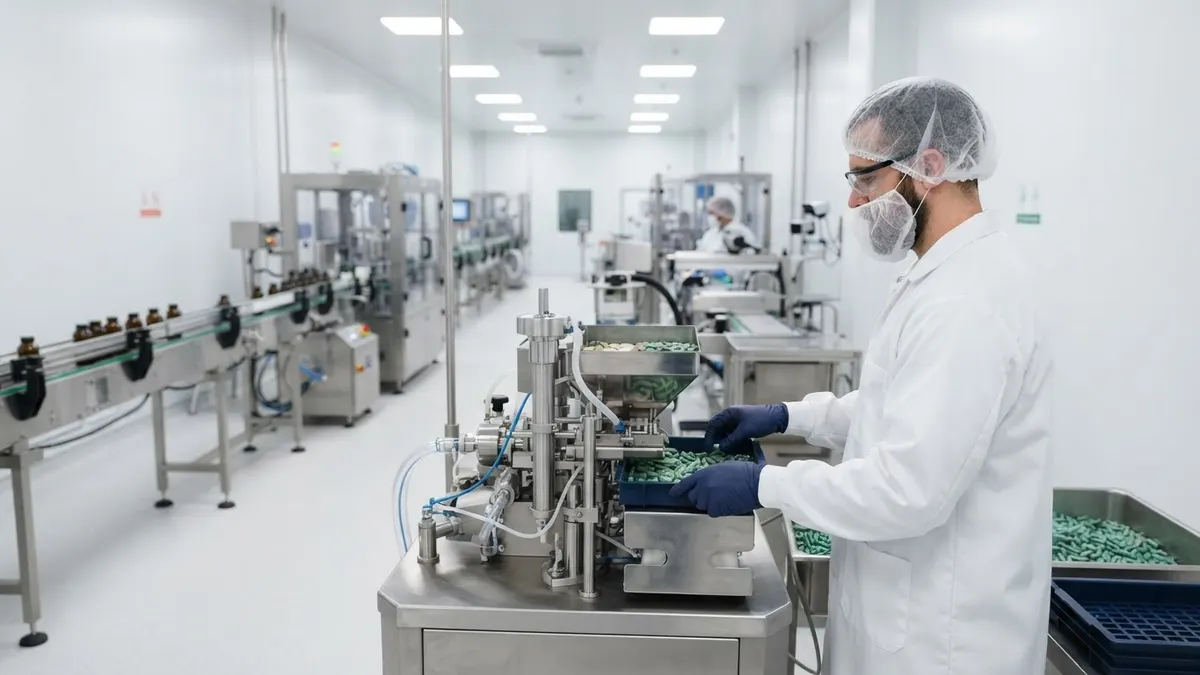
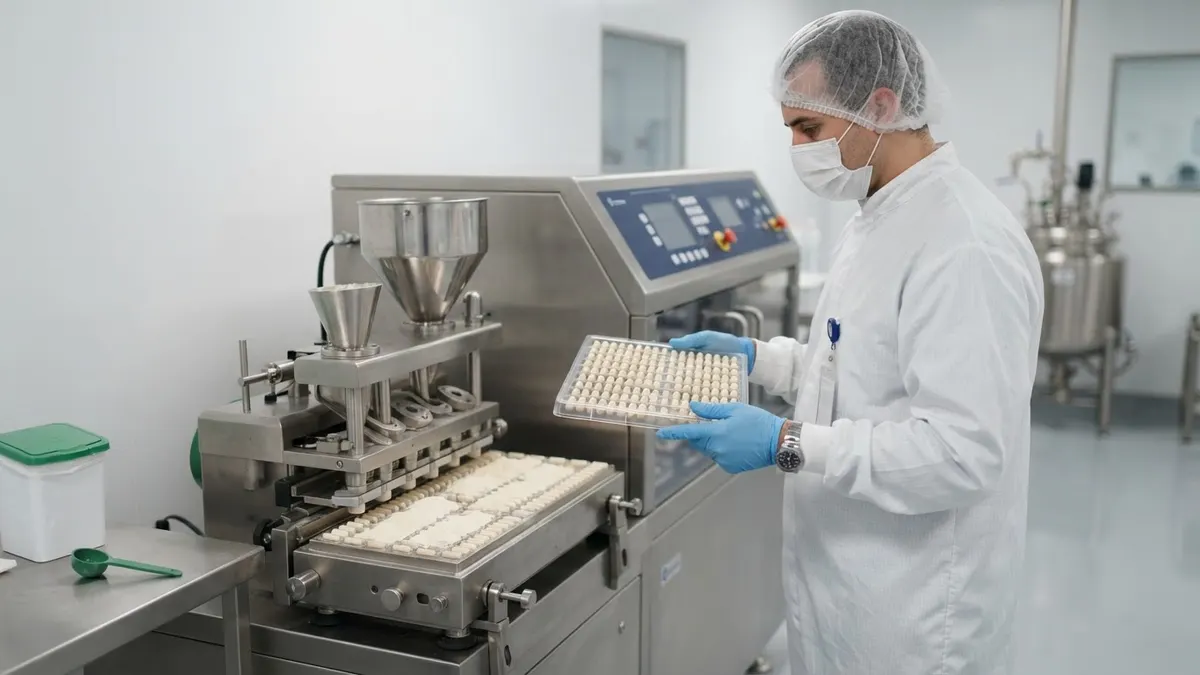
A hard capsule has two parts: a body and a cap. The encapsulation machine separates them, fills the body with a measured dose of blend and presses the cap back on. Larger runs use fully automatic machines. Smaller runs may use semi-automatic equipment.
Fill weight is checked again and again during the run. Operators pull samples at set intervals, weigh them and adjust the machine. A drift of a few milligrams sounds small, but across thousands of capsules it means some customers get less than the label promises.
Capsule size sets how much fits. A size 00 capsule, common in supplements, often holds somewhere around 500 to 800 mg depending on how dense the powder is. If your serving is 1,500 mg of a light herbal powder, plan on three capsules, not two.
Polishing, inspection, bottling and release testing: the finishing steps
Step 5: Polishing
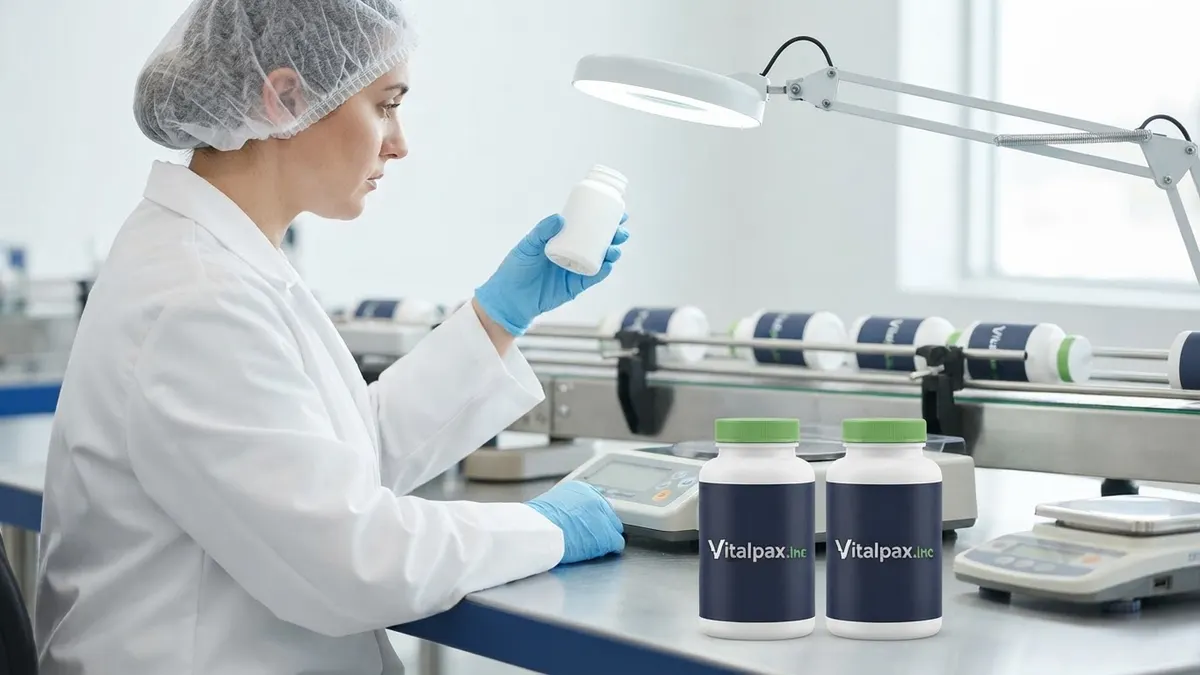
Capsules leave the filling machine with a fine coat of dust. A polisher brushes or tumbles them while a vacuum pulls the powder away. Clean capsules look better in the bottle, clump less and run more smoothly through counting equipment.
Step 6: Inspection
Inspection removes dented, split, poorly closed or under-filled capsules. Weights are checked across samples to confirm the run stayed within its limits. This is quality built into the process, not a single check bolted on at the end.
Step 7: Bottling and labeling
Capsules are counted into bottles. A desiccant may be added to absorb moisture, then the bottle is sealed, capped and labeled with its lot number and date. Vitalpax offers packaging including PCR bottles, jars, tubs, glass bottles, blister packs, pouches and custom options.
Labels carry their own rules. California AB 660, for example, standardizes date-label wording for covered products made on or after July 1, 2026, and dietary supplements are not specifically exempted. Read our guide to California AB 660 before you approve label artwork.
Step 8: Release testing
Before a batch ships, the finished product is checked against its specification. In a cGMP plant, finished product specifications generally cover identity, strength or composition, purity and limits on contaminants. The exact tests depend on the formula and the markets you sell into.
Vitalpax applies stringent, industry-standard quality control and laboratory testing with HPLC and FTIR. Whoever you work with, ask for the finished product COA, ask which tests it covers and keep it with your batch records. If you want to understand why certifications and documentation matter at this stage, see Proof of Quality: Why Certifications Count.
Gelatin vs vegetable capsules: what is the difference?
The shell is part of your product. It affects who can buy it, how it handles moisture and what it costs.
| Factor | Gelatin capsules | Vegetable capsules |
|---|---|---|
| Made from | Animal collagen, usually from cattle, pigs or fish | Usually HPMC (hypromellose) from plant cellulose, or pullulan made by fermentation |
| Who it suits | General market; Halal or Kosher buyers only when the gelatin source is certified | Vegetarian and vegan buyers; often a simpler path for Halal and Kosher |
| Moisture | Holds more water; can turn brittle in dry storage or soft in humid storage | Holds less water; often preferred for moisture-sensitive ingredients |
| Cost | Usually lower per capsule | Usually higher per capsule |
| Label claims | Cannot carry vegan or vegetarian claims | Supports vegan and vegetarian claims |
Gelatin makes sense when your buyers have no dietary restrictions, your ingredients are not moisture-sensitive and cost per bottle is a priority.
A plant-based shell fits better when you sell to vegan or vegetarian customers, when you want one product that works across many markets, or when your blend reacts badly to moisture.
Shell choice ties directly to certifications. Vitalpax offers Halal and Kosher supplement certification and runs a USDA Organic certified facility. A Halal, Kosher or organic claim covers the whole capsule, so the shell must qualify too. Ask about current shell options and their certification status when you request a quote.
How long does a capsule production run take from formula to finished bottle?
The filling run itself is often the shortest part of the timeline. Most of the calendar goes to the steps around it:
- Formula sign-off. The formula, dose and capsule count are locked.
- Ingredient sourcing. Common ingredients arrive quickly. Specialty extracts or organic materials can take far longer.
- Ingredient testing. Each lot is held until it passes.
- Production. Weighing, blending, encapsulation, polishing, inspection and bottling.
- Finished product testing. The batch waits for results before release.
- Shipping. Domestic or international, depending on your channel.
What usually causes delays:
- Hard-to-find ingredients, or ingredients that fail incoming testing and must be replaced.
- Late label approval, which leaves finished capsules waiting for bottles.
- Formula changes after sourcing has already started.
Vitalpax states a 57% faster turnaround time than the competition. For a timeline on your own formula, request a quote with your full checklist ready. To keep your launch on schedule, lock the formula before ingredients are ordered and approve label artwork early.
Checklist and common mistakes before your first capsule run
Have these ready before you ask for a quote:
- Final formula with every ingredient and its amount
- Target dose per serving and capsules per serving
- Capsule count per bottle
- Shell type: gelatin or vegetable
- Packaging choice
- Label artwork, or at least a draft
- Certifications you need, such as organic, Halal or Kosher
- The markets and sales channels you plan to sell into
Three mistakes come up again and again:
- A formula that will not fit. A long ingredient list at full doses can need four or five capsules per serving. Customers notice. Check the fit during formulation, not after the label is printed.
- Ignoring label rules for your markets. Date wording, claims and ingredient names vary by market. California’s date-label rules are one recent example.
- Choosing on price alone. A lower quote means little if testing is thin or paperwork is missing. Ask what is tested, when, and what documents you will receive.
What affects the cost of making capsules?
Four things drive most of the price:
- Ingredients. Specialty extracts, standardized actives and organic materials cost more than common vitamins and minerals.
- Batch size. Small batches let you test the market with less cash tied up. Larger batches spread setup and testing costs over more bottles, so the cost per bottle drops.
- Capsule details. Shell type, capsule size and capsules per serving all change the number of shells and the machine time per bottle.
- Packaging and certifications. Glass costs more than plastic. Blister packs take more work than bottles. Organic, Halal and Kosher claims add sourcing and documentation steps.
The trade-off is usually cash now versus cost per unit. A new brand often starts small, proves demand, then moves to larger runs. Vitalpax supports both large and small batches, so the same partner can carry you through that shift.
For a worked example of these choices on a single ingredient, see the essentials of high-quality magnesium supplement manufacturing.
Ready to make your capsule product? Your next step with Vitalpax
Vitalpax is a U.S.-based, cGMP-compliant contract manufacturer on a multi-building campus in Southern Utah. We take brands from concept to shelf:
- In-house R&D and formulation to create, improve or reverse-engineer a formula.
- Full-service manufacturing across capsules, tablets, softgels, powders, stick packs and liquids.
- Packaging and private label, with bottles, jars, glass, blister packs and custom options.
- Laboratory testing with HPLC and FTIR, inside a cGMP and USDA Organic certified facility.
- Large and small batches, so new and growing brands both fit.
Gather the checklist above, then request a quote from Vitalpax or call +1 866 848 2588. We will walk through your formula, shell choice and packaging, and show you how each step of the capsule manufacturing process applies to your product.
Frequently asked questions
How are supplement capsules made?
Ingredients are tested, weighed to the formula and blended until even. Machines then fill the blend into two-piece capsule shells and close them. The capsules are polished, inspected, bottled and labeled, and the finished product is checked against its specification before release.
What are the steps in the capsule manufacturing process?
There are eight main steps: raw material testing, weighing, blending, encapsulation, polishing, inspection, bottling and labeling, and release testing. Each step is recorded in a batch record so every bottle can be traced back to its ingredient lots. Catching problems at the early steps costs far less than finding them at the end.
What is the difference between gelatin and vegetable capsules?
Gelatin capsules are made from animal collagen and usually cost less per capsule. Vegetable capsules are usually made from plant cellulose (HPMC) or pullulan, suit vegetarian and vegan buyers, and hold less moisture. For Halal, Kosher or organic claims, the shell must qualify along with the ingredients.
How long does a capsule production run take from formula to finished bottle?
It depends mostly on ingredient sourcing and testing, not the filling run itself. Specialty or organic ingredients, late label approval and formula changes are the most common causes of delay. Vitalpax states a 57% faster turnaround time than the competition; contact us with your formula for a timeline on your product.
What testing happens before capsules are released?
In a cGMP plant, the finished product is checked against its specification before it ships, which generally covers identity, strength, purity and contaminant limits. The exact tests depend on the formula and target markets. Vitalpax applies stringent, industry-standard quality control and laboratory testing with HPLC and FTIR. Ask your manufacturer for the finished product certificate of analysis and which tests it covers.
What is capsule manufacturing, and what does a contract manufacturer do?
Capsule manufacturing is the process of filling measured doses of a powder blend into capsule shells at scale, with the same amount in every capsule. A contract manufacturer runs that process for your brand in a cGMP facility, handling testing, production, packaging and batch records. Your brand owns the formula and the label.
What does a capsule manufacturing process flow chart look like?
A simple flow chart runs: raw material testing → weighing → blending → encapsulation → polishing → inspection → bottling and labeling → release testing. Each step feeds the next, and material only moves forward once it passes its checks.
What do I need to provide to a private label supplement manufacturer to start making capsules?
Bring your final formula, dose per serving, capsules per serving, count per bottle, shell type, packaging choice and label artwork. Also list any certifications you need, such as organic, Halal or Kosher, and the markets you plan to sell into. If your formula is not final yet, Vitalpax’s in-house R&D and formulation team can help create or refine it.