

A stick pack manufacturer in the USA takes your formula, blends it into an even powder, fills it into slim single-serve packets, seals each one against moisture and packs them for sale, all under cGMP rules. The right partner handles formulation, blending, filling and quality checks in one place, so every packet matches your label. Before you ask for a quote, know your serving size, how your powder behaves, and which film and carton you want. This guide covers all three and ends with a checklist you can send.
What does a stick pack manufacturer in the USA do?
A stick pack is a long, narrow single-serve packet. The customer tears the top and pours one serving into water. Behind that simple packet is a chain of steps, and a stick pack contract manufacturer runs all of them:
- Formula review. Checking that the ingredients, amounts and label claims work together in a powder and fit one packet.
- Sourcing and incoming checks. Buying raw materials from qualified suppliers and testing them for identity and purity before use.
- Blending. Mixing the batch so every packet carries the same amount of each active ingredient.
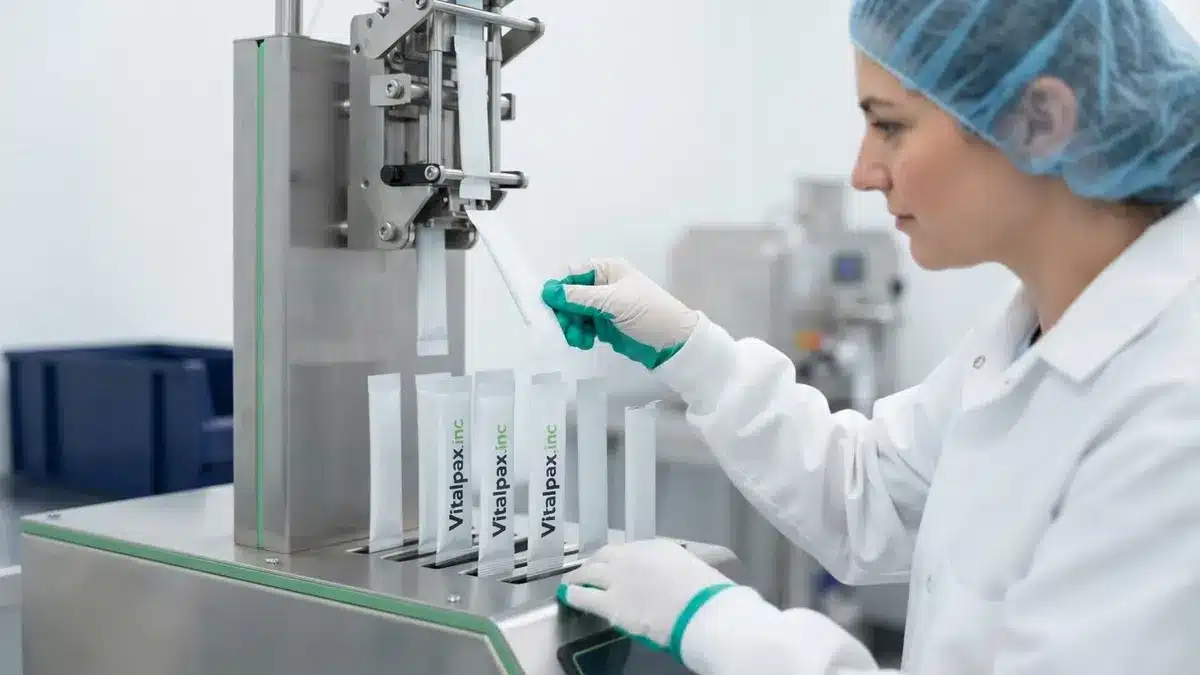
- Filling and sealing. Forming packets from a roll of film, filling them to a set weight and sealing them shut.
- Packing and release. Counting packets into cartons, checking the finished product against its specification and reviewing the batch record before it ships.
In the U.S., the cGMP rules for dietary supplements are set out in 21 CFR Part 111. They cover how a manufacturer verifies ingredient identity, controls each production step and keeps batch records.
Why do brands choose stick packs?
- One exact serving. No scoop, no guessing. The customer gets the labeled amount every time.
- Easy to carry. A packet fits a gym bag, a desk drawer or a pocket.
- Easy to sample. Trial packs, event giveaways and subscription add-ons are simple to build.
- A good fit for online and Amazon sales. Cartons of packets ship flat and stack well.
Making stick packs in the U.S. also means one partner for formula and packaging, shorter shipping routes to your warehouse, and a quality system you can visit and audit. For the full powder process from ingredient list to filled product, read our guide to powder supplement manufacturing in the USA.
What can be filled into a stick pack?
Most free-flowing powders and many granules suit the format. Drink mixes are the most common fit:
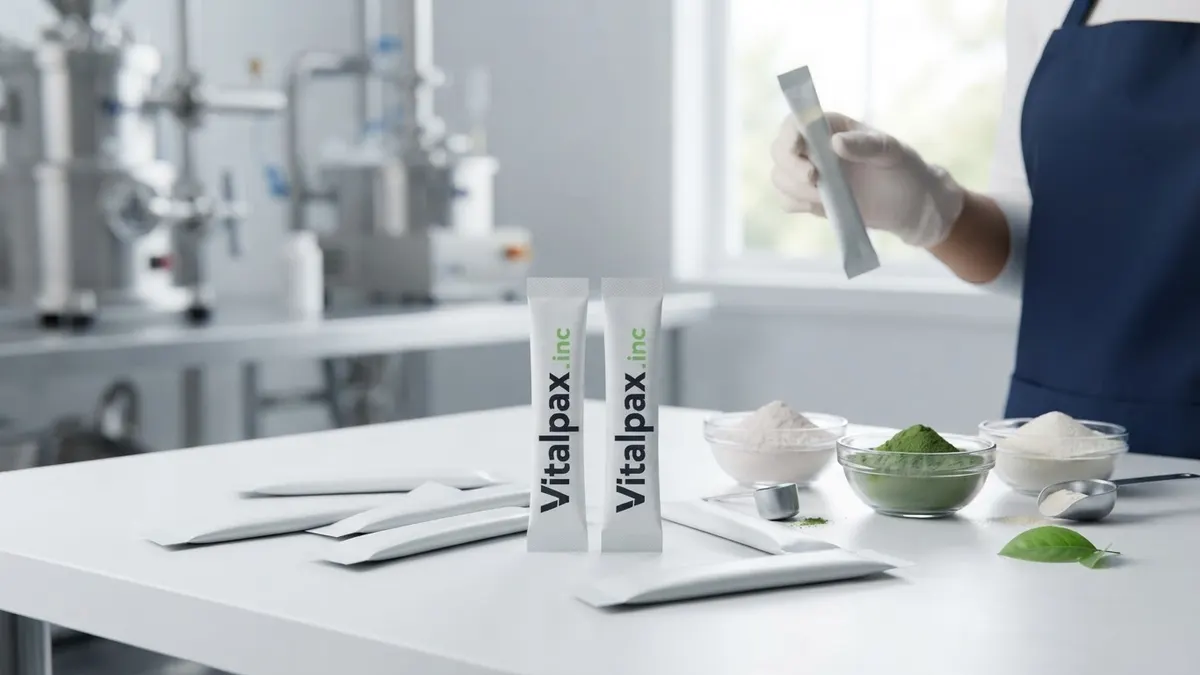
- Electrolyte and hydration mixes
- Greens and superfood blends
- Collagen
- Pre-workout and energy mixes
- Amino acid blends
- Fiber
- Minerals such as magnesium (see our article on magnesium supplement manufacturing)
Which products need more care?
- Sticky or oily blends. Powders with oils, some extracts or high sugar content can smear the seal area or bridge in the filling tube.
- Very fine powders that dust. Dust settles in the seal and can cause weak or leaking seals.
- Ingredients that pull moisture from the air. They clump in the hopper, harden in the packet and need stronger film.
None of these rule out a stick pack. They just mean more work at the formulation stage and a closer look at the film.
Stick pack or sachet?
A stick pack is narrow and long. A sachet is flatter and wider, usually sealed on three or four sides. A sachet often suits a bigger or bulkier serving, such as a protein or meal-style shake, because it holds more volume without becoming awkward to open. A stick pack suits smaller drink-mix servings and looks neater in a retail box.
A simple test: if one serving does not fit comfortably in one packet, rethink the serving size or the format before anything else. Two packets per serving annoys customers and doubles your packaging cost.
How to choose the right fill weight for a stick pack
Fill weight is the total weight of powder in one packet. Get it right early, because it drives packet size, film order, carton size and cost per serving.
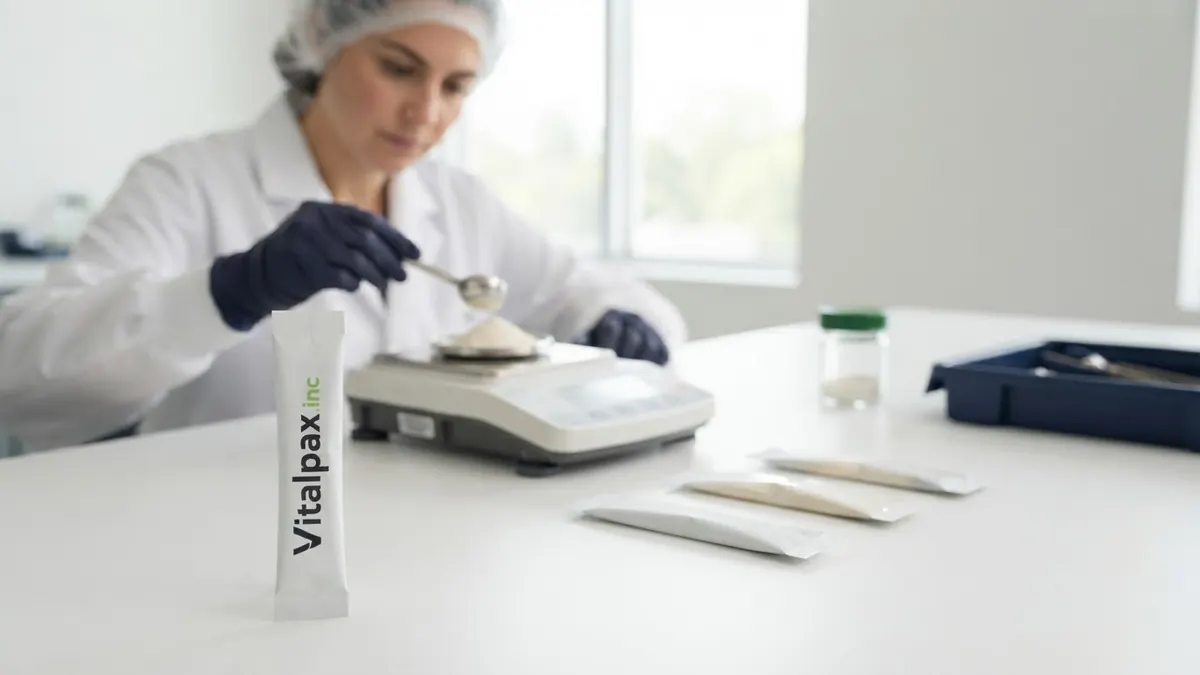
Start from the label
Begin with the amount of each active ingredient per serving. Then add everything else the powder needs: flavor, sweetener, color, acids and anything that helps it mix. Here is a worked example you can repeat with your own numbers:
- List the actives per serving. Say they add up to 4.2 g.
- Add flavor, sweetener and acids from your bench sample. Say 1.5 g.
- Add any flow aid or mixing aid. Say 0.1 g.
- Your fill weight is 5.8 g. That is the number on your spec and your label serving size.
Why volume matters as much as weight
Two powders at the same weight can need very different packets. A light, fluffy greens blend takes far more space than a dense mineral blend. Ask your manufacturer to measure the bulk density of your actual blend (grams per set volume). That number tells you how long and how wide the packet must be, with room left above the powder for a clean seal.
Why packets are filled a little over
No filling machine puts the exact same weight in every packet. There is always some packet-to-packet variation. To make sure no packet falls below what the label states, the target is set slightly above the label amount. During the run, packets are weighed at set intervals and adjusted if they drift. Ask any manufacturer how they set the target and how often they check weights.
Test before you lock it in
Make bench samples at the planned serving and fill a few packets by hand or on a short trial. Mix one in the amount of water on your directions. Taste it. Check that it dissolves. Only then fix the packet size. Changing it after film is printed costs time and money.
What makes a powder suitable for stick pack filling?
Stick packs are filled through a narrow tube. That makes the format less forgiving than a tub. Three things decide whether a powder runs smoothly or jams, clumps and fills unevenly.

Flow
The powder must pour freely, like dry sand, not cling like flour. Sticky or clumping powders bridge in the tube. The result is packets that are light, heavy or partly empty in the same run.
Particle size and mixing
When ingredients have very different particle sizes, they can separate during filling. Fine particles sift down. Coarse ones rise. The first packets of a run can carry a different amount of an active than the last. Matching particle sizes, or choosing a different grade of an ingredient, keeps the blend even from start to finish.
Moisture and heat
Some ingredients soak up water from the air and harden. Moisture control has to work in three places at once: the room where filling happens, the blend itself and the film that seals it.
What can a formulation team change?
- Swap to a different form of an ingredient that flows or dissolves better.
- Add a small amount of a flow aid, such as silicon dioxide, where the label allows it.
- Adjust the blend so particle sizes are closer together.
- Granulate or agglomerate a fine powder so it pours and mixes better.
These fixes are easier when formulation and production sit under one roof. Vitalpax has in-house R&D and formulation and works with 7,000+ unique ingredients a year. That breadth helps when a formula needs a specific ingredient form to flow, taste or dissolve well. Read more about how we use 7,000+ ingredients in custom formulations.
Stick pack packaging options: film, print, seals and cartons
Every stick pack supplier will ask you to choose film, print, packet details and cartons. Here is what each choice means.
Film
Stick pack film is usually a laminate: thin layers bonded together. The layers decide how well the packet keeps out moisture, oxygen and light.
| Film type | Protection | Look | Relative cost | Best use |
|---|---|---|---|---|
| Clear plastic laminate | Lowest barrier to moisture and light | Shows the powder | Lower | Stable powders that do not need a long shelf life, where seeing the color helps |
| White or printed plastic laminate | Moderate; blocks some light | Clean, full-color print | Lower to moderate | Everyday drink mixes that are not sensitive to moisture |
| Metallized film | Better barrier than plain plastic film | Shiny metallic finish | Moderate | Blends that need more protection at a moderate cost |
| Foil-lined laminate | Strongest barrier to moisture, oxygen and light | Premium, opaque | Higher | Moisture-sensitive, probiotic-style or light-sensitive formulas |
Basic plastic film costs less but protects less. If your formula pulls in moisture, the savings can disappear in clumped product and returns.
- Printed film. Your design is printed on the roll before filling. It looks finished on shelf and in hand. It needs final artwork, a printing proof and usually a minimum film order from the film printer, which adds setup time.
- Plain film. Faster to start and easier for small runs. The full label sits on the carton instead, and the packet may carry only basic details such as lot number and date.
Packet details
- Width and length, set by your fill weight and bulk density
- An easy tear notch so customers can open it without scissors
- Seal style and pattern
- Finish, such as matte or gloss
- Lot code and date printed on each packet
Cartoning
Decide how many packets go in each box, then how the boxes are packed:
- Retail or display boxes for store shelves and counters.
- Shipping cases for warehouse and fulfillment.
- Marketplace-ready boxes with the right barcode and labeling if you sell on Amazon.
Ask each manufacturer whether cartoning is done in-house or by another company, because it affects lead time and who answers for the finished unit.
Stick pack costs and trade-offs to plan for
Stick pack pricing is built from a handful of drivers:
- The formula and its ingredients
- Packet size and fill weight
- Film type
- Printed film setup
- Carton style and packets per carton
- Order quantity
Why does a serving cost more in a stick pack than in a tub?
Each serving gets its own film, seal and space in a carton. A tub holds many servings in one container. So the cost per serving is usually higher in stick packs. Brands still choose them for the exact serving, easy samples, travel packs and low-risk trial offers that turn first-time buyers into repeat customers. Many brands sell both: a tub for daily users and stick packs for trial and travel.
Small first runs or large runs?
A small first run tests the product and the market before you commit to large film and carton orders. A larger run lowers the cost per unit once demand is proven. Vitalpax has both large and small batch capabilities, so a brand can start small and scale with the same partner.
Where do delays come from?
- Late or changing artwork
- Flavor changes after sampling
- Ingredients with long sourcing times
- Film and carton orders placed after the formula is final rather than in parallel
Mistakes to avoid when launching a stick pack product
These come up again and again from the manufacturer’s side of the table:
- Picking the packet size before testing the real powder. Bulk density decides the packet. A size chosen from a competitor’s product rarely fits your blend.
- Approving flavor from a tub-sized sample. Taste it at one-packet strength, mixed in the exact amount of water on your directions.
- Choosing the lowest-cost film for a moisture-sensitive formula. Clumped packets cost more than the film savings.
- Sending artwork before the facts are final. Lock the label facts, serving size and carton count first. Reprinting film is slow and expensive.
- Comparing quotes built on different briefs. If one supplier quoted foil film and another quoted clear film, the lower price tells you nothing. Send every supplier the same brief.
Stick pack quote checklist: what to prepare before you ask
Copy this list into your email or quote form. The more of it you fill in, the more accurate and faster your first quote will be.
Product
- Formula or ingredient list with amounts per serving
- Flavor goals and any sweetener preferences
- Certifications you need, for example organic, halal or kosher
Packet
- Target fill weight
- Preferred packet size, if you have one
- Film type
- Printed film or plain film with a labeled carton
- Tear notch and finish
Packing
- Packets per carton
- Carton style: retail, display or shipping only
- Case packing
- Where you will sell: your own website, Amazon, stores or export
Volume and timing
- First order quantity
- Expected repeat orders
- Your launch date
Documents you expect back
- Product specification
- Batch records
- Finished-product test results
Comparing several partners? Use our private label supplement manufacturer checklist to score each one on the same points.
Next step: get your stick pack quote from Vitalpax
Vitalpax is a cGMP-compliant U.S. contract manufacturer on a multi-building manufacturing campus in Southern Utah. We make powders, sachets and stick packs alongside capsules, tablets and liquids, so one partner can carry your line across several formats.
We work from formula to market:
- In-house R&D and formulation
- Full service manufacturing
- Packaging and private label
- International shipping and certifications
- Amazon registration and marketing expertise
- Large and small batch capabilities
The details at the start matter. Send us the checklist above with your request, and we can build a quote around your real formula, packet and carton. Contact Vitalpax to start your stick pack project.
References
- 21 CFR Part 111: Current Good Manufacturing Practice in Manufacturing, Packaging, Labeling, or Holding Operations for Dietary Supplements (Electronic Code of Federal Regulations, eCFR)
Frequently asked questions
What can be filled into a stick pack?
Most free-flowing powders and granules suit stick packs, especially drink mixes such as electrolytes, greens, collagen, pre-workout, amino blends, fiber and minerals like magnesium. Sticky or oily blends, very fine dusty powders and ingredients that pull moisture from the air can still work, but they need more formulation work and often a stronger film.
How do I choose the right fill weight for a stick pack?
Start with the amount of each active ingredient per serving, then add flavor, sweetener and any flow or mixing aids to get the total weight. Check the bulk density of your actual blend, because a fluffy powder needs a bigger packet than a dense one at the same weight. Make bench samples at the planned serving and taste them at one-packet strength before you fix the packet size.
What makes a powder suitable for stick pack filling?
The powder must flow freely through a narrow filling tube, keep an even mix without separating by particle size, and resist picking up moisture. When a powder clumps or separates, a formulation team can switch to a different ingredient form, add a flow aid where the label allows, or adjust the blend.
What packaging options come with stick packs?
You choose the film (clear, white, metallized or foil-lined), whether the film is printed with your design or left plain, and packet details such as size, tear notch, seal style and finish. You also choose cartons: packets per box, retail or display boxes, shipping cases and marketplace-ready packing for Amazon.
What should I prepare before asking a stick pack manufacturer for a quote?
Prepare your formula with amounts per serving, flavor goals and any certifications you need, plus target fill weight, film type and print choice. Add packets per carton, carton style, where you will sell, first order quantity, expected repeat orders and your launch date. List the documents you expect back, such as the product specification, batch records and finished-product test results.
How do I find a stick pack manufacturer in the USA?
Look for a U.S. partner with a cGMP quality system that makes powders and stick packs in-house and can handle formulation, filling and packaging together. Send every candidate the same brief so their quotes can be compared fairly. Vitalpax is a cGMP-compliant contract manufacturer in Southern Utah that makes powders, sachets and stick packs.
What is the difference between a stick pack and a sachet?
A stick pack is a long, narrow single-serve packet, while a sachet is flatter and wider and usually sealed on three or four sides. Sachets often suit larger or bulkier servings, and stick packs suit smaller drink-mix servings and pack neatly into retail boxes.
Do stick pack contract manufacturers also handle formulation and cartoning?
Many do, but it varies, so ask each one directly whether formulation and cartoning happen in-house. Vitalpax offers in-house R&D and formulation, full service manufacturing, and packaging and private label, from formula to market.