

What does a liquid supplement manufacturer in the USA do?
A liquid supplement manufacturer in the USA turns your formula into a mixed, flavored and tested liquid that is filled, capped, sealed and labeled under cGMP rules. The right partner handles formula review, ingredient sourcing, flavor work, mixing, filling and quality checks in one place, so every bottle matches the label.
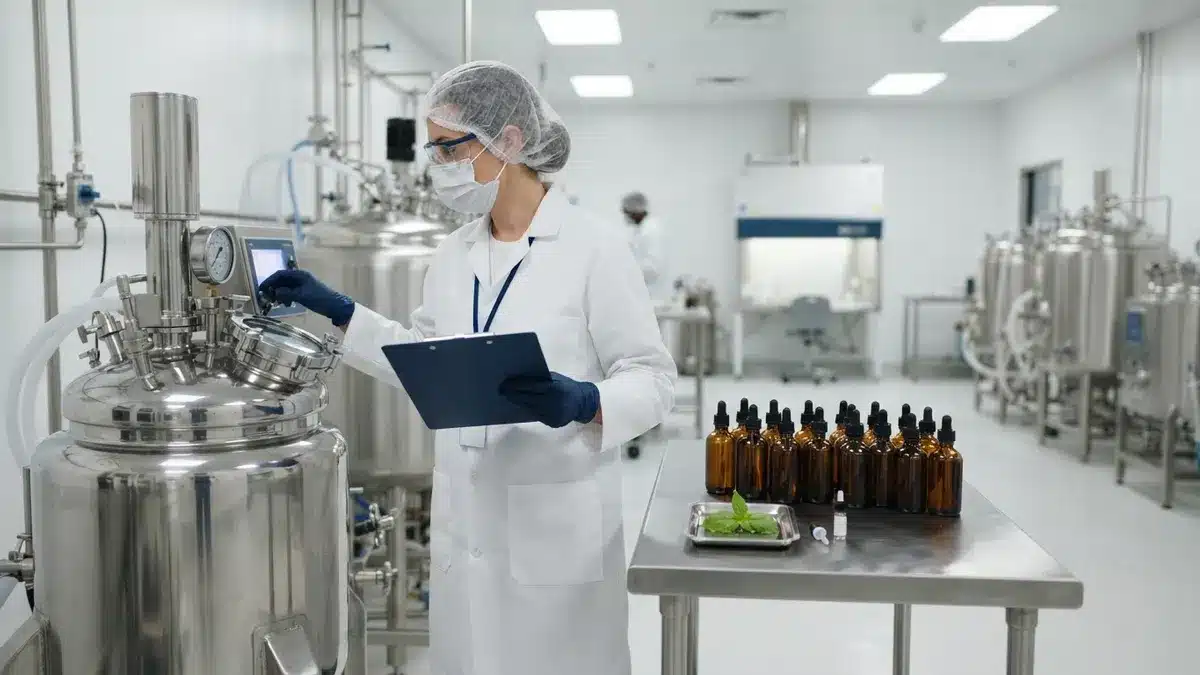
Not every contract manufacturer makes liquids. Many focus on capsules or powders and send liquid work to another plant, or do not offer it at all. That makes the choice of partner matter more for a liquid product than for most other formats.
This guide covers what brands need to know before they commit:
- When a liquid is the right format, and when it is not
- How liquid manufacturing runs, step by step
- Fill sizes from 1 oz to 32 oz, and how to pick one
- Flavor, preservation and shelf life
- Bottle and closure choices
- The questions to ask a liquid dietary supplement manufacturer before your first run
Why brands choose liquid supplements (and when another format fits better)
Liquids solve real problems for customers. They are easy to swallow, which matters to anyone who dislikes pills. They are easy to dose, from a few drops to a full measuring cup. And they can be taken straight or stirred into water, juice or a smoothie.

Common liquid products include:
- Liquid minerals, such as liquid magnesium. Our magnesium supplement manufacturing guide covers this category.
- Herbal extracts, such as turmeric drops. See our turmeric supplement manufacturing article for format choices.
- Liquid multivitamins for adults and children who would rather not swallow tablets.
- Pet wellness oils that owners add to food. Read more about our pet supplement work.
Liquids also have trade-offs. Weigh them honestly before you commit:
- Weight. Water is heavy. A 32 oz bottle of liquid weighs roughly two pounds before you count the bottle and box. That raises shipping costs.
- Taste. A capsule hides flavor. A liquid cannot. Bitter herbs and minerals need real flavor work.
- Shelf life. Water gives ingredients the chance to react, separate or spoil. Liquids need more care with preservation and testing.
- Packaging. Bottles, caps and seals must stop leaks and protect sensitive ingredients from light and air.
How do liquids compare with other supplement formats?
| Factor | Liquids | Capsules | Tablets | Powders | Stick packs |
|---|---|---|---|---|---|
| Serving size | Drops to a full cup; flexible | Limited by capsule size | Limited by tablet size | Grams per scoop; large doses fit | One fixed single serving |
| Taste | Fully exposed; needs flavor work | Hidden | Mostly hidden; coating helps | Exposed; needs flavor work | Exposed; needs flavor work |
| Shelf life | Hardest to manage | Usually simpler | Usually simpler | Moisture is the main risk | Sealed single doses help |
| Shipping weight | Heaviest | Light | Light | Moderate | Light |
| Ease of use | Easy to swallow; no mixing needed | Must swallow | Must swallow | Must mix | Portable; must mix |
When does another format fit better? If your formula needs a high dose of an ingredient that tastes harsh and breaks down in water, a capsule or tablet is often simpler. If customers want a large daily serving they mix into a drink, a powder or stick pack usually ships lighter and holds up longer. Compare the options in our guides to how capsules are made, how tablets are made and powder supplement manufacturing in the USA.
The liquid supplement manufacturing process, step by step
Every liquid project follows roughly the same order. Knowing it helps you prepare, ask better questions and see where delays usually start.

- Formula and ingredient review. The formulation team checks every ingredient, amount and planned label claim. Will each ingredient dissolve? Will it stay mixed, or settle to the bottom? Will it stay stable in water for the life of the product? An ingredient that works well in a capsule may need a different form to work in a liquid.
- Sourcing and incoming checks. Raw materials come from qualified suppliers. They are held and checked for identity and purity before anyone uses them.
- Bench samples and flavor trials. Small samples are made to dial in taste, sweetness, color and texture. This happens before the full run, because changing a flavor after a large batch is mixed is expensive.
- Mixing. Ingredients are weighed to the batch formula and mixed in a set order, so each serving carries the same amount of each active ingredient.
- Filling, capping and sealing. The liquid is filled to the set volume, capped, sealed against tampering and leaks, and labeled.
- Final checks and release. Finished product is checked against the product specification. The batch record is reviewed. Only then does the product ship.
Most delays start at steps one and three. A formula that will not dissolve, or a flavor that needs several rounds, adds time. Access to the right form of an ingredient helps here. Vitalpax works with 7,000+ unique ingredients a year, which gives the formulation team options when one form will not behave in a liquid.
What fill sizes are available for liquid supplements?
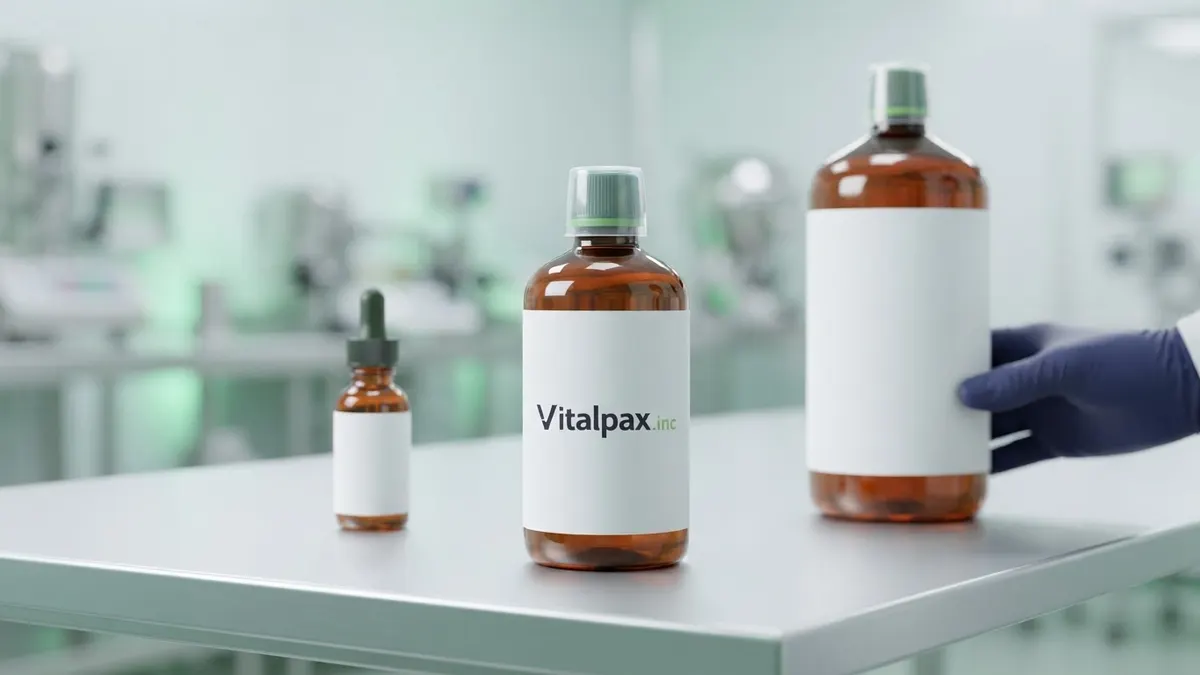
Vitalpax fills liquids from 1 oz to 32 oz. The right size depends on your serving, your price point and how fast customers use the bottle.
| Size range | Approx. volume | Typical use |
|---|---|---|
| 1 to 2 oz | 30 to 60 mL | Concentrated extracts and drops dosed with a dropper |
| 4 to 8 oz | 120 to 240 mL | Smaller daily servings by the teaspoon; liquid vitamins |
| 16 to 32 oz | 475 to 945 mL | Daily drinks, tablespoon servings, family or value sizes |
How do you pick the right fill size?
Start with simple math: bottle volume divided by serving size equals servings per bottle.
- A 1 oz dropper bottle holds about 30 mL. At a 1 mL serving, that is about 30 servings, or one month at one serving a day.
- A 16 oz bottle holds about 475 mL. At a 15 mL (one tablespoon) serving, that is about 31 servings.
- A 32 oz bottle holds about 945 mL. At a 30 mL serving, that is also about one month.
Then check three more things:
- Price point. A bigger bottle raises the price per unit. Make sure it still fits where you sell.
- Use after opening. If a bottle lasts three months but the product should be used sooner once opened, choose a smaller size.
- Shipping and marketplaces. Larger liquids weigh more and have more leak risk. Marketplaces such as Amazon have their own prep rules for liquids, so check current seller guidance and plan your box size before you lock in the bottle.
How flavor and shelf life are handled for liquid dietary supplements
Taste and shelf life are the hardest parts of any liquid. They are also linked. Changes made to fix one often affect the other.
Why are liquids harder than dry formats?
In a capsule or powder, ingredients sit dry and mostly still. In a liquid, water lets them move, react and separate. Some vitamins lose strength faster in water. Minerals can make a liquid cloudy or leave sediment. Botanicals can darken or change taste over time. And water supports microbial growth if the product is not protected.
How is flavor developed?
Good flavor work starts with the hardest ingredient. Minerals such as magnesium and herbs such as turmeric can taste bitter, metallic or earthy. A flavor team masks them with sweeteners, flavors and acids, then tests the result.
- Decide early whether you want sugar, a sugar-free sweetener or both. It shapes the whole formula.
- Taste samples at the strength customers will take them, straight or diluted, not just from the mixing beaker.
- Approve a flavor only after you have tasted a sample that has sat for a while, not just a fresh one.
How do manufacturers keep liquids fresh?
Three tools do most of the work:
- Preservatives. Many liquids use an added preservative. Some formulas use naturally preserving ingredients such as glycerin bases or high levels of sugar. Each choice affects taste and label claims.
- pH. Many preservatives work best in a more acidic liquid. Adjusting pH can help shelf life but changes the taste.
- Filling and sealing. Clean filling, tight caps and tamper seals keep air and contaminants out until the customer opens the bottle.
How is the shelf life on the bottle supported?
The date you print should rest on stability testing: storing finished product and checking it over time for strength, appearance, taste and microbial quality. Shelf life also changes once a bottle is opened. Some liquids need refrigeration after opening; the label should say so. Ask your manufacturer how stability testing is run for your product and what data backs the date.
Date label wording is also getting more attention. If you sell in California, read our note on California AB 660 date label rules.
What bottle and closure options work for liquid supplements?
Packaging for a liquid does more than look good. It protects the product, controls the dose and keeps it from leaking in transit.
Bottle materials
- Glass resists reaction with most ingredients and suits premium extracts. It is heavier and can break in shipping.
- Plastic is lighter and tougher in transit. Check that the plastic type suits your formula, especially oils and high-alcohol extracts.
- Amber or opaque bottles block light, which helps ingredients that fade or break down in light. Clear bottles show off color but offer less protection.
Closures
- Dropper caps for drops and concentrated extracts in small bottles.
- Screw caps for larger servings poured by the spoon or cup.
- Pumps or measuring cups when the dose needs to be exact and repeatable.
- Tamper-evident seals such as induction seals or shrink bands, which also help stop leaks.
Which bottles and caps a manufacturer can run on its filling lines varies, so confirm the options before you design your label.
A quick packaging checklist
- Does the bottle material suit the ingredients and any oils or alcohol in the formula?
- Does the closure match the dose: drops, teaspoons or cups?
- Is the bottle large enough to leave room above the fill line?
- Is there room on the label for the facts panel, directions and warnings?
- Will the bottle, cap and seal survive shipping to your customer or a marketplace warehouse?
Common mistakes brands make with their first liquid supplement
- Trusting the formula on paper. A formula can look fine on a spreadsheet and taste bitter in the bottle. Do not skip flavor trials.
- Choosing packaging first. A beautiful bottle that does not suit the ingredients, closure or fill size means a costly redesign.
- Printing shelf life without data. A date on the bottle should be backed by stability testing, not a guess.
- Splitting production. A manufacturer that sends liquids to another plant adds a handoff, another quality system and more chances for delay.
- Leaving labels and export paperwork to the end. Label rules and certificates for other markets take time. Start them alongside the formula.
Questions to ask a liquid supplement manufacturer before your first run
Ask every liquid supplement company on your list the same questions, in the same order, and write down the answers during the call. Then compare them side by side, as in our private label supplement manufacturer checklist.
- Do you make liquids in your own facility under cGMP? Can you share current certificates?
- What fill sizes, bottles and closures can you run on your lines?
- How do you handle flavor trials, preservation and stability testing?
- Do you test incoming ingredients and finished product? Do you provide batch records and test results?
- Can you run both small and large batches as we grow?
- Do you support private label packaging, Amazon requirements and export paperwork?
- Who is my named contact, and how will you tell me about delays?
Certificates and test records are the proof behind every answer. Our article on why certifications count explains what to look for.
Why choose a U.S. manufacturer for liquid supplements?
A U.S. partner works under U.S. cGMP rules for dietary supplements, and you can visit or audit the plant without long travel. Shipping to U.S. customers and warehouses is shorter, which matters for heavy liquids. And for distributors selling abroad, U.S.-made products with clear paperwork are familiar to many buyers and regulators. These points carry the most weight when you compare liquid dietary supplement contract manufacturers on quality and supply.
Next step: plan your liquid supplement with Vitalpax
Vitalpax is a cGMP-compliant contract manufacturer on a multi-building campus in Southern Utah. We make liquids alongside capsules, powders, tablets and stick packs, so your liquid can sit in the same quality system as the rest of your line.
- In-house R&D and formulation, with 7,000+ unique ingredients a year to shape a liquid that tastes right and holds up.
- Liquid fills from 1 oz to 32 oz.
- Large and small batch capabilities.
- Packaging and private label, international shipping and certifications, and Amazon registration and marketing expertise.
The details at the start matter. Before your first call, have these ready:
- Your formula, or the idea and key ingredients
- Target serving size and servings per bottle
- Preferred fill size and packaging style
- Sales channels: DTC, Amazon, retail or distribution
- Target markets, in the U.S. and abroad
Ready to talk through your formula? Contact the Vitalpax team to plan your liquid supplement from concept to shelf and request a quote.
Frequently asked questions
What fill sizes are available for liquid supplements?
Vitalpax fills liquids from 1 oz to 32 oz. Small sizes suit concentrated drops and extracts, while larger sizes suit daily drinks and value sizes. To choose, divide the bottle volume by your serving size to see how many servings each bottle holds.
How is shelf life handled for liquid dietary supplements?
Shelf life in a liquid depends on the formula, preservatives, pH, and how cleanly the product is filled and sealed. The date printed on the bottle should be backed by stability testing of finished product over time. Ask your manufacturer how stability testing is run for your product and whether the product needs refrigeration after opening.
What bottle and closure options work for liquid supplements?
Common choices are glass or plastic bottles, in amber or opaque colors for light-sensitive ingredients. Dropper caps suit drops, screw caps suit spoon or cup servings, and pumps or measuring cups help when the dose must be exact. Options vary by manufacturer, so contact the Vitalpax team to confirm which bottles and closures fit your product.
What should I ask a liquid supplement manufacturer before my first run?
Ask whether they make liquids in their own facility under cGMP and can share current certificates. Ask what fill sizes, bottles and closures they run, how they handle flavor trials and stability testing, and whether they test incoming ingredients and finished product. Also ask about small and large batch runs, private label support, and export or Amazon needs.
Why choose a U.S. manufacturer for liquid supplements?
A U.S. manufacturer works under U.S. cGMP rules for dietary supplements and is easier to visit or audit. Shipping heavy liquids to U.S. customers and warehouses is shorter. Vitalpax is a U.S.-based, cGMP-compliant contract manufacturer in Southern Utah with international shipping and certifications support.
How do I find a liquid dietary supplement contract manufacturer I can trust?
Score each manufacturer on the same areas: quality and certifications, formats made in-house, ingredient sourcing and testing, documents and labeling support, and communication and ability to scale. Ask for current certificates and sample batch paperwork rather than relying on logos. A manufacturer that answers clearly and shares documents without fuss is a good sign.
Can a liquid supplement company make my product under my own private label?
Yes. Vitalpax makes capsules, tablets, softgels, powders, stick packs and liquids for brands under their own labels. Its turnkey services include packaging and private label, along with in-house R&D and formulation.
Are liquid supplements harder to make than capsules or powders?
In several ways, yes. Water lets ingredients react, separate or spoil, so liquids need more work on flavor, preservation and stability. Packaging also has to stop leaks and protect sensitive ingredients from light and air.