

Are powder supplements better than pills?
Are powder supplements better than pills? Not in general. Neither format wins on its own. The right choice depends on your dose size, how the formula tastes, how your customers like to take it and what each serving costs to make. Powders suit large servings and drink-style products, while capsules and tablets suit small doses and grab-and-go routines.
This guide compares the formats from a brand’s point of view: what each one does well, what it costs you in development and packaging, and where launches go wrong. It makes no health claims about any format. Whether a supplement is better in powder or pill form is a product decision, not a wellness one.
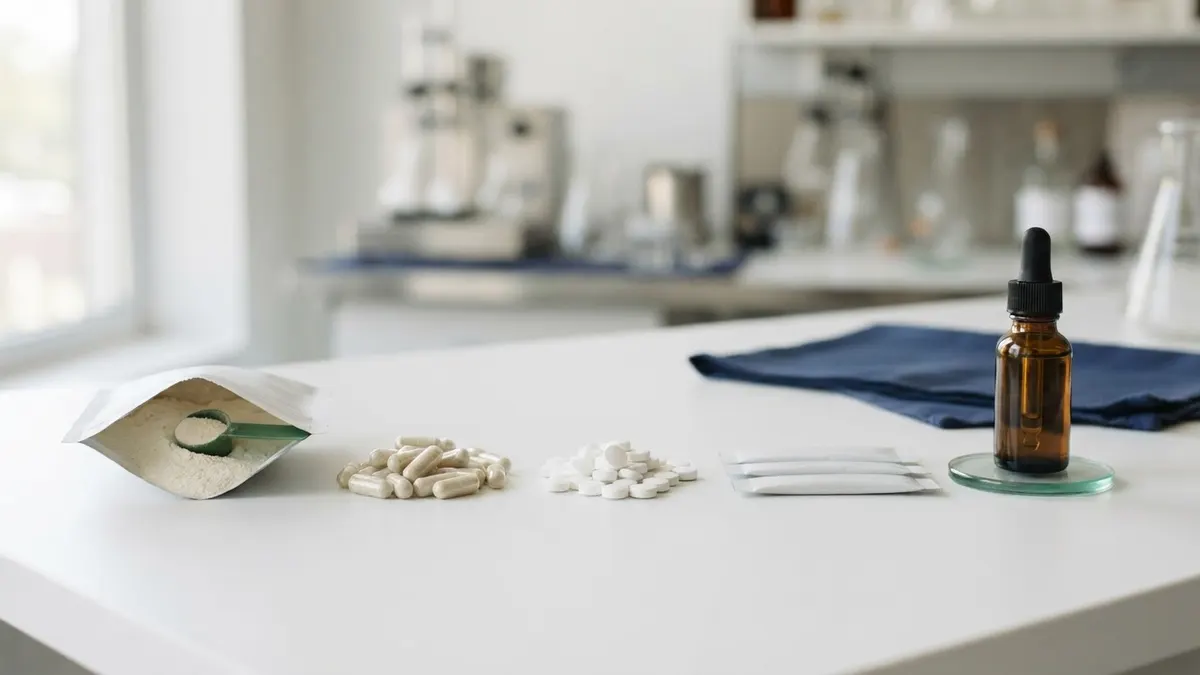
Powder vs. capsule vs. tablet vs. stick pack vs. liquid: side-by-side comparison
Use this table to narrow the field before you talk to a manufacturer. Read each row as a set of trade-offs, not a score.
| Format | Dose size per serving | Taste and flavor needs | Daily convenience | Shelf stability and packaging | Main cost drivers | Best-fit product types |
|---|---|---|---|---|---|---|
| Powder in tubs or pouches | Large. A scoop holds grams of material. | High. Flavor is part of the product, so it needs sweetener, flavor and mixability work. | Needs a scoop and a drink. Dosing is flexible (half a scoop or two). | Needs moisture protection. Seal quality and container choice matter. | Flavor system, fill weight per serving, tub or pouch | Protein, greens, electrolytes, pre-workout, collagen, fiber, amino acid blends |
| Capsules | Small. A serving is a set number of capsules. | Low. The shell hides most taste and smell. | Portable and quick. No mixing, but serving count matters. | Sealed bottles keep them well. Shell type is a choice to make early. | Capsules per serving, shell type, count per bottle | Herbal extracts, vitamins, small-dose targeted blends |
| Tablets | Small to medium. Pressing can fit more material into one unit than a capsule, but large tablets are harder to swallow. | Low to medium. A coating can mask taste or smell. | Portable and quick. Size, shape and coating affect how easy they are to swallow. | Hold up well in sealed bottles. Coating can add protection. | Binders, granulation, coating, count per bottle | Multivitamins, minerals, high-count daily products |
| Stick packs or sachets | One measured powder serving per pack. | High. Same flavor work as a tub powder. | The most portable powder. No scoop, easy to carry. | Each serving is sealed in its own film, so the rest stay closed. | Film, per-unit filling, cartons | Electrolytes, drink mixes for travel or the gym, sample packs |
| Liquids | Measured by volume, in bottles from small to large. | High. Flavor and mouthfeel both matter. | No pills and no mixing, though customers still measure a dose. | Depends on the formula. Bottle and closure choice matter. | Bottle size, flavor, formula stability work | Drops, shots, syrups, products for customers who avoid pills |
A few notes on reading the table:
- A “high” is a trade-off, not a winner. High flavor needs mean more development work, but they also give you a product people may enjoy taking.
- Start with dose size. It rules out formats faster than any other column. If your serving is several grams, pills become a handful.
- Then picture the customer. Where are they when they take it? At a kitchen counter, in a gym bag, at a desk?
Vitalpax makes capsules, powders, tablets, sachets and stick packs, and liquids under cGMP. So when you work with us, the format choice is about your product, not about what the supplier happens to run.
When does a powder make more sense than a capsule or tablet?
A powder is usually the stronger choice in four situations.

1. Your serving is measured in grams
This is the most common reason. Capsules and tablets hold far less material per unit than a scoop. Do the math with your own formula:
- Add up the total weight of one serving, including actives and any supporting ingredients.
- Ask your manufacturer how much of your specific blend fits in one capsule or tablet. It depends on how dense the blend is.
- Divide the serving weight by the fill per unit.
Say your serving is 5 g and one capsule holds about half a gram of your blend. That is ten capsules a day. Few customers stick with that. The same 5 g is one easy scoop.
2. Your customers do not like swallowing pills
Some buyers will not take pills at all. A powder lets them stir the serving into water, milk, a smoothie or coffee. If your reviews, surveys or support emails mention pill size, take that seriously.
3. Taste is part of the habit
A good-tasting drink can become part of someone’s morning. Capsules and tablets cannot offer that. This is why protein, greens, electrolytes, pre-workout and collagen are so often sold as powders.
4. You want flexible dosing
With a scoop, your directions can allow half a serving or two. That is harder to offer with a fixed capsule count.
What powders ask of you in return
- Flavor development. Bench samples and flavor trials come before the full run. Changing a flavor after thousands of units are blended is expensive.
- Mixability. Some ingredients float, sink or leave grit. The ingredient form you choose affects how well the powder dissolves.
- Moisture control. Powders can clump if moisture gets in. Packaging and seals need planning, not just a nice label.
- Even blending. Every scoop has to carry the same amount of each active. Our powder supplement manufacturing guide walks through how that is done.
When capsules or tablets are the better choice
Pills earn their place too. Choose a capsule or tablet when:
- The dose is small and precise. If two capsules cover the full serving, there is little reason to add flavor work and a tub.
- An ingredient has a strong taste or smell. A capsule shell or a coated tablet hides it. A powder would need heavy flavor work, and it may still come through.
- Customers want portability with no mixing. A pill bottle fits in a bag and needs nothing else.
Capsules vs. tablets: what is the difference?
The tablet and capsule manufacturing process starts the same way: ingredients are checked, weighed and blended. Then they split.
- Capsules fill a measured dose of powder blend into two-piece shells. The capsule process runs in eight stages: raw material testing, weighing, blending, encapsulation, polishing, inspection, bottling and labeling, and release testing. See the full capsule manufacturing process.
- Tablets press a blend into a firm shape. The steps can include an ingredient check, milling, blending, granulation, drying, compression, coating, inspection and packaging. Not every tablet needs every step; the formula decides. See the full tablet manufacturing process.
In practice, the choice often comes down to three things:
- Size. A tablet can often hold more per unit, but a large tablet is harder to swallow.
- Taste and look. A coating can make tablets easier to swallow, mask taste or smell, and add a finished look. Capsules offer shell colors and a clean appearance.
- Formula behavior. Some blends press well. Others need granulation or binders. Some fill shells evenly with little help. Your manufacturer’s formulation team will tell you which path is shorter for your blend.
Which supplement format is easiest for customers to take every day?
Repeat orders depend on whether customers actually take the product. Here is how each format holds up in daily life.
- Stick packs: One serving per pack. Easy to toss in a gym bag, carry-on or desk drawer. No scoop, no measuring.
- Capsules and tablets: The fastest to take. But serving count matters. One or two a day is easy. Six a day is a chore, and follow-through tends to drop.
- Tub powders: Good value per serving and a ritual-style habit at home. They need a scoop, a drink and a few seconds of shaking.
- Liquids: No pills and no mixing. A good fit for customers who avoid both.
A quick way to decide: picture where and when your customer takes it. A morning shake at the kitchen counter points to a tub. A mid-afternoon drink at the office points to stick packs. A quick dose before leaving the house points to capsules or tablets.
Many brands sell the same powder in both a tub and stick packs. The tub serves loyal daily users. The stick packs serve travel, gifting and first-time trial.
Do powders cost more or less to make than capsules?
It depends more on your formula than on the format. A high-dose formula costs more in any format, because the ingredients themselves are often the largest line on the quote. Format changes what you pay for around those ingredients.
Powder cost drivers
- Flavor, sweetener and mixability work during development
- Fill weight per serving
- Container choice: tub, pouch or stick pack film
- Moisture protection, such as seals and liners
Capsule and tablet cost drivers
- Number of units per serving (more units means more fill, more shells or more pressing)
- Shell type for capsules
- Granulation and coating for tablets
- Count per bottle
Packaging can swing the total
Packaging can change the cost per serving as much as the fill does. A tub, a pouch, a carton of single stick packs and a bottle of capsules all price differently, even with the same blend inside.
The most useful step: ask your manufacturer to quote the same formula in two formats. Compare the real cost per serving, not the cost per unit. A bottle of 60 capsules at two per serving is 30 servings. A tub with 30 scoops is also 30 servings. That is the fair comparison.
Can the same formula be made as both a powder and a capsule?
Often, yes. But the formula rarely stays identical. The actives can stay the same while the supporting ingredients and serving size change to suit each format.
- Powder: may need flavor, sweetener and flow helpers so it tastes good and mixes well.
- Capsule: needs a blend that fills shells evenly, sometimes with a flow agent.
- Tablet: needs a blend that presses and holds together, often with binders or granulation.
Ingredient form matters here. The right form of an ingredient can be the difference between a powder that dissolves cleanly and one that sits at the bottom of the glass. Vitalpax works with 7,000+ unique ingredients a year, which gives a formulation team room to choose the form that suits each format.
Launching two formats from one formula can widen your customer base while keeping one product story. A customer who will not swallow pills buys the powder. A customer who travels a lot buys the capsules. Your marketing stays the same.
Mistakes brands make when choosing a format
From the manufacturing side, these are the errors we see most often.
- Forcing a large dose into capsules. If the math says eight capsules a day, rethink the format or the serving.
- Leaving flavor until late. Flavor decisions belong in the bench sample stage. Changing taste after a full batch is planned costs time and money.
- Ignoring moisture. Powders that are not protected from moisture can clump. Plan the container and seal with the formula, not after it.
- Choosing a format your manufacturer sends out. If one plant makes the capsules and another makes the powder, every handoff adds lead time and risk. When you compare powder supplement companies, ask which formats they make in their own facility. Our private label manufacturer checklist covers what else to ask.
- Skipping label rules for each market. Check label and date-label requirements for every market before packaging is printed. For example, see what supplement brands should know about California AB 660 date-label rules.
Next step: talk through your formula with a manufacturing partner
The details at the start matter. Bring these to your first call and the format decision gets much faster:
- Your formula, or a draft ingredient list
- Dose per serving for each ingredient
- Your target customer and how you picture them taking it
- Your preferred packaging (tub, pouch, stick packs, bottle)
- The markets you plan to sell in
Vitalpax is a cGMP-compliant contract manufacturer on a multi-building campus in Southern Utah. We make capsules, tablets, powders, stick packs and sachets, and liquids, with in-house R&D and formulation to help settle the format before production starts. Large and small batch runs are both available, so you can test a second format without overcommitting.
Not sure whether your product should be a powder, a pill or both? Contact Vitalpax to compare formats for your own formula and take it from concept to shelf.
Frequently asked questions
Are powder supplements better than pills?
Neither format is better in general. Powders suit large servings measured in grams and drink-style products where taste builds a habit. Capsules and tablets suit small, precise doses and customers who want something portable with no mixing. The right choice depends on your dose size, taste, customer habits and cost per serving.
When does a powder make more sense than a capsule or tablet?
A powder makes more sense when the serving is large enough that pills would mean a handful a day, when customers prefer not to swallow pills, when good taste helps build a daily habit, or when you want flexible dosing such as half a scoop or two. Common powder categories include protein, greens, electrolytes, pre-workout, collagen and fiber.
Which supplement format is easiest for customers to take every day?
It depends on where and when they take it. Capsules and tablets are fastest when the serving is one or two units. Stick packs are the most portable powder option, and tub powders suit a routine at home. Liquids avoid both pills and mixing.
Do powders cost more or less to manufacture than capsules?
Cost depends more on the ingredients and dose size than on the format alone. Powders add flavor, mixability and container costs, while capsules and tablets add costs per unit, shell type or coating. The fairest comparison is to ask your manufacturer to quote the same formula in both formats and compare cost per serving.
Can the same formula be made as both a powder and a capsule?
Often, yes, though the serving size and supporting ingredients usually change. A powder may need flavor, sweetener and flow helpers, while a capsule needs a blend that fills shells evenly. Vitalpax works with 7,000+ unique ingredients a year, which helps a formulation team pick the right ingredient form for each format.
Are supplements better in powder or pill form for a new brand?
Start with your dose per serving and your target customer. If the serving is several grams or the product is meant to be a drink, a powder usually fits; if the dose is small, capsules or tablets are simpler to launch. Vitalpax offers in-house R&D and formulation and both large and small batch runs, so a new brand can settle the format before production starts.
What is the difference between the tablet and capsule manufacturing process?
Both start by checking, weighing and blending ingredients. Capsules are then filled into two-piece shells, polished, inspected, bottled and tested before release. Tablets are pressed into shape and may also be milled, granulated, dried and coated, depending on the formula.
What should I look for in powder supplement companies?
Look for cGMP compliance, careful ingredient testing, flavor and bench sample work before the full run, blending that keeps every scoop consistent, and packaging that protects against moisture. Ask which formats they make in their own facility, since sending work to other plants adds handoffs. Vitalpax makes powders, stick packs, capsules, tablets and liquids under cGMP in Southern Utah.