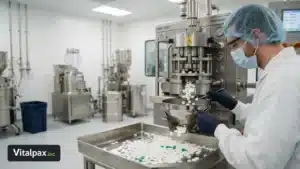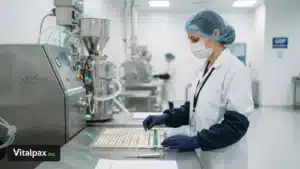


A powder supplement manufacturer in the USA takes your formula from an ingredient list to a blended, flavored, tested powder that is filled, sealed and labeled under cGMP rules. The right partner handles formulation, sourcing, blending, flavor work, filling and quality checks in one place, so every scoop matches the label. This guide covers each step, how to compare powder supplement companies, and what to prepare before you ask for a quote.
What is powder supplement manufacturing?
Powder manufacturing turns a list of ingredients into one even, free-flowing powder, then fills it into tubs, pouches or single-serve stick packs. For a supplement brand, a contract manufacturer runs that whole path: formula review, raw material sourcing, weighing, blending, flavor development, testing, filling and labeling.
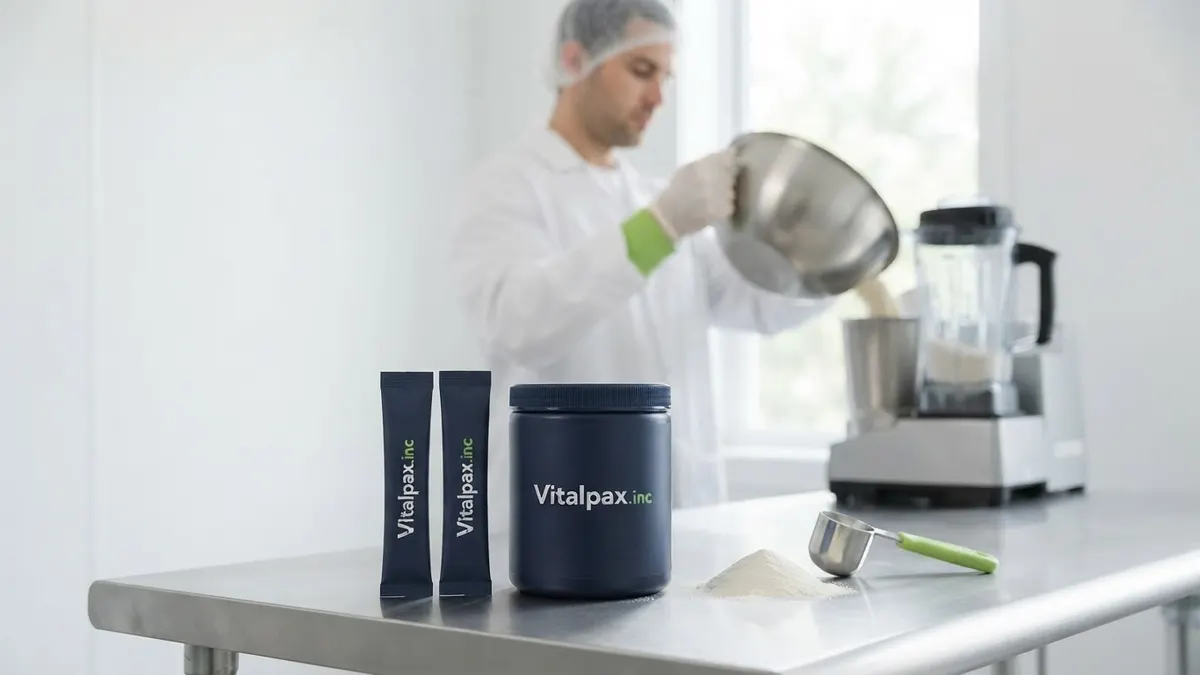
You own the brand and the customer. Your manufacturing partner owns the production.
Brands choose powders for a few practical reasons:
- Larger servings. A scoop holds grams of material. Capsules and tablets hold far less per unit, so a high-dose formula can mean a handful of pills.
- Easy to take. Customers stir powders into water, milk, smoothies or coffee. That suits people who do not like swallowing pills.
- Room for flavor. A good-tasting drink builds a daily habit. Capsules and tablets cannot do that.
- Flexible dosing. Customers can take half a scoop or two scoops, depending on the directions.
Common powder categories include protein, greens, electrolytes, pre-workout, collagen, fiber, amino acid blends and minerals such as magnesium.
The powder manufacturing process, step by step
Every powder project follows roughly the same order. Knowing it helps you ask better questions and spot where delays come from.
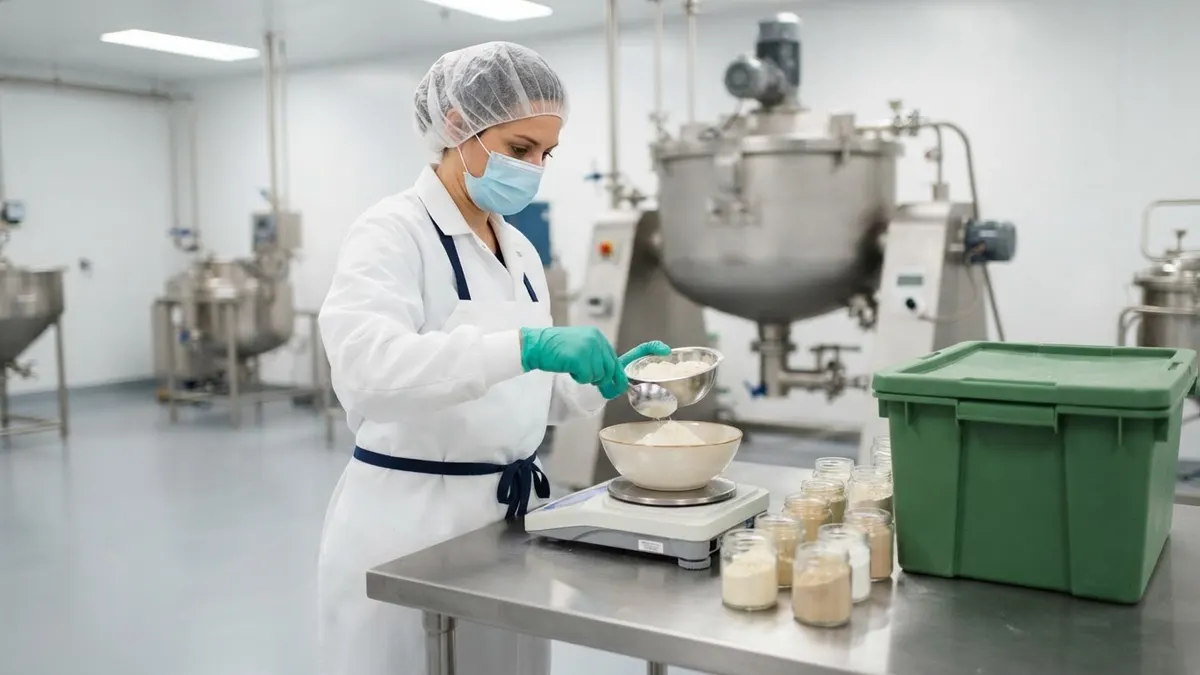
- Formula and ingredient review. The formulation team checks every ingredient, amount and planned label claim. Do the ingredients work together in a powder? Does the serving size fit the container? Will any ingredient react with another, clump or break down?
- Sourcing and incoming checks. Raw materials are bought from qualified suppliers, then held and checked for identity and purity before anyone uses them.
- Bench samples and flavor trials. Small samples are made to dial in taste, sweetness, color and mixability. This happens before the full run, because changing a flavor after thousands of units are blended is expensive.
- Weighing and blending. Each ingredient is weighed to the batch formula and mixed so every scoop carries the same amount of each active.
- Filling, sealing and labeling. The blend is filled into tubs, pouches or stick packs, sealed against moisture and labeled.
- Final checks and release. Finished product is checked against the specification, the batch record is reviewed, and only then does the product ship.
Vitalpax supports brands from concept to full-scale production, with in-house R&D and formulation and access to 7,000+ unique ingredients a year. That breadth matters at step one, when a formula needs a specific form of an ingredient to blend, taste or dissolve well.
How supplement powders are blended so every scoop is consistent
Blending is where powder quality is won or lost. A capsule is filled one unit at a time. A powder batch is one large mix, and each scoop has to be a faithful slice of it.
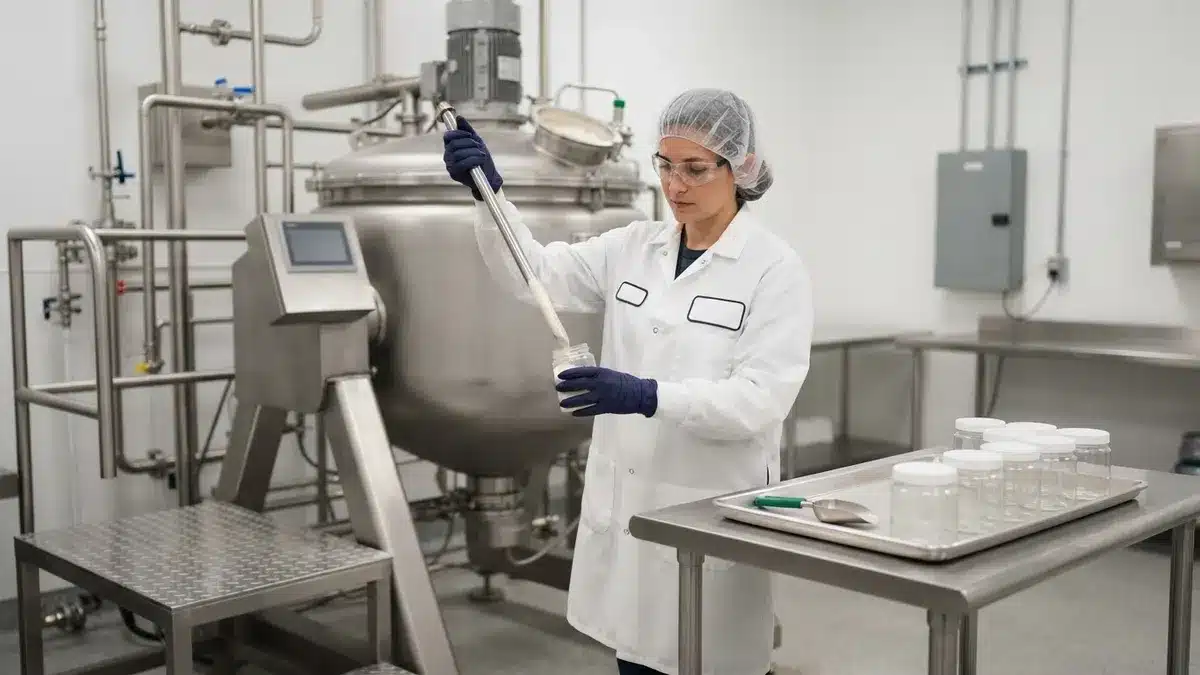
Here is why that is hard. Say your formula has 500 mcg of a vitamin in a 10 g serving. That vitamin is 0.005% of the blend. Drop it straight into a large blender with everything else, and it can end up concentrated in one corner of the batch.
Pre-blend the small ingredients first
Good makers mix micro ingredients, such as some vitamins and minerals, with a small portion of a carrier ingredient first. That pre-blend then goes into the main batch. Building up in stages spreads tiny amounts evenly instead of hoping a big mixer finds them.
Match the blender and mixing time to the batch
Different blenders suit different powders and batch sizes. Mixing time is set and controlled, not guessed. Too short leaves pockets of unmixed material. Too long can cause some powders to separate again or break down fragile particles.
Stop ingredients from separating after blending
A perfectly mixed batch can still separate later. Fine, heavy particles sink. Large, light particles rise. Vibration during filling, trucking and warehouse handling speeds this up.
Makers reduce separation by:
- Choosing ingredient grades with similar particle sizes where possible.
- Using granulated or agglomerated forms of ingredients that tend to drift.
- Filling soon after blending, with gentle handling between steps.
Prove it with sampling
The only way to know a blend is even is to test it. Samples are pulled from several points in the batch, such as the top, middle and bottom, and checked for a marker ingredient. If results match across locations, the batch is uniform.
When you compare powder supplement companies, ask a direct question: how do you confirm blend uniformity for a formula like mine? A careful maker will explain the method without hesitation.
How flavor and mixability are developed for a powder supplement
Customers judge a powder in the first sip. If it tastes bad or clumps, the tub sits in the cupboard and they do not reorder.

Covering difficult ingredients
Many useful ingredients taste bitter, salty, sour or earthy. Caffeine, some amino acids, mineral salts and botanical extracts are common culprits. Flavor development usually combines:
- Flavors that suit the base taste. Citrus and berry often hide bitterness better than delicate flavors.
- Sweeteners such as sugar, stevia, monk fruit or sucralose. Each tastes different and fits a different label story, so decide early whether you want a natural-only label.
- Acids and masking agents that balance sweetness and soften off-notes.
Mixability: clumping, foam and grit
A powder that tastes great but sits in a lump at the bottom of the glass still fails. Common problems and fixes:
- Clumping: often caused by fine particles or ingredients that pull in moisture. Instantized ingredients and flow aids help.
- Foam: some proteins and fibers foam when shaken. Ingredient choice and processing can reduce it.
- Grit: insoluble ingredients leave sediment. Finer grades or a different ingredient form can fix it.
What sample rounds look like
Expect more than one round. A first sample shows where the flavor stands. The next rounds adjust sweetness, flavor strength and texture based on your feedback. Very bitter or high-dose formulas take more rounds than simple ones.
Test every sample at the real serving size, in the liquid and amount your label will recommend, at the temperature customers will use. A tiny taste on a spoon tells you very little.
The trade-off: flavor takes space
Flavor systems add weight to every serving. If your actives total 8 g and the flavor and sweetener system adds 2 g, your scoop becomes 10 g. That changes container size, servings per container and cost. Agree on the balance between taste and scoop size before you lock the formula.
Tubs vs stick packs: choosing how your powder is filled
The container affects cost, shelf presence, shipping and how customers use your product. Here is how the three common options compare.
| Format | Packaging cost per serving | Convenience | Shelf appeal | Shipping | Best use |
|---|---|---|---|---|---|
| Tub | Usually lowest | Needs a scoop; suited to home use | Large front panel, strong retail presence | Bulky, carries empty headspace | Daily use, repeat buyers, multi-serving products |
| Pouch | Low to moderate | Light; resealable with a zipper | Flat front panel, good for DTC | Light and compact | Value sizes, refills, online sales |
| Stick pack | Usually highest, since each serving gets its own film and seal | Pre-measured and portable | Sold in cartons; good for counter displays | Light and compact | Trials, samples, travel, on-the-go use |
Many brands use more than one format. A tub serves regular buyers at a better cost per serving. Stick packs let new customers try the product, travel with it or receive it as a sample.
Moisture and freshness
Many powders pull moisture from the air. Electrolytes, some sweeteners and certain amino acids are known for it. Moisture causes caking, color change and weaker actives over time.
Protection comes from the whole system: a tight seal on tubs, barrier films on pouches and stick packs, and a dry filling environment. Choose packaging after you know how sensitive your formula is, not before.
Can one manufacturer fill both tubs and stick packs?
Working with one partner for several formats keeps the product the same. One blend, one flavor system and one set of records means your tub and your single servings taste and test alike. With two suppliers, you manage two specifications and risk two slightly different products under one brand.
Vitalpax fills powders into tubs today, and sachets and stick packs are part of its format range. If your plan includes single-serve packs, mention it in your quote request so the team can confirm the options for your product.
Testing and quality checks for powder supplements
Quality is built into the process, not added at the end. A careful U.S. maker checks the product at every stage:
- Incoming ingredients: identity and purity checks before an ingredient is released for production.
- In-process checks: blend checks, plus fill weight checks at regular intervals during the run so every container holds what the label says. Seal checks matter for moisture-sensitive powders.
- Finished product: checks against the specification so what is on the label is what is in the container.
- Records: batch records that show who did what, when, with which ingredient lots.
In the U.S., dietary supplement makers follow current Good Manufacturing Practice (cGMP) rules. Those records matter when a retailer, marketplace or distribution partner asks for proof of quality. They also matter when you need to trace a lot back to its ingredients.
Vitalpax is a cGMP-compliant contract manufacturer and maintains a suite of industry-recognized certifications. Read more about why certifications count when you choose a manufacturer.
What to look for in a powder supplement manufacturer in the USA
Use this checklist when you compare powder supplement companies:
- cGMP compliance and a willingness to explain how they meet it.
- In-house formulation help, so ingredient and serving problems get solved before production, not during it.
- Wide ingredient access, so the right form of each ingredient is available.
- Flavor development with real sample rounds.
- The fill formats you need, now and for your next SKU.
- Large and small batch options, so you can launch lean and scale without changing partners.
- Clear paperwork, from specifications to batch records.
Certifications for your market
Some markets and retailers expect certifications such as USDA Organic, Halal, Kosher or Non-GMO Project Verified. Selling in regions such as Europe, Canada or the Middle East may also require production in certified facilities. Ask which certifications apply to your product before formulation starts, because they can limit which ingredients you use.
Help beyond the factory
A contract manufacturer that also handles packaging, private label, international shipping and Amazon registration saves you from coordinating several vendors. Vitalpax offers all of these as turnkey services, along with large and small batch capabilities. Vitalpax also supports pet brands as a Preferred Supplier of the National Animal Supplement Council, including pet products such as oral care powders.
Red flags
- Vague answers about testing or blend checks.
- No samples before the full run.
- No clear timeline or no named contact for your project.
Common mistakes brands make with powder supplements
- Approving flavor from a tiny sample. Always mix a full serving in the real liquid before you sign off.
- Packing too much into one scoop. Every extra ingredient adds weight and taste. A formula that needs a 30 g scoop to hit its doses may need a rethink.
- Choosing packaging first. Check how sensitive your formula is to moisture, then pick the container and seal.
- Underestimating label rules. Date wording is one example. California’s AB 660 date-label law standardizes wording for covered products made on or after July 1, 2026, and dietary supplements are not specifically exempted.
- Asking for a quote with no formula or target price. A vague request gets a vague answer and slows the whole project.
What you need before requesting a powder supplement quote
The details at the start matter. A complete request gets you an accurate quote faster. Gather these first:
- Your formula, with each ingredient and amount per serving. If you do not have one, describe the goal of the product and your target customer.
- Serving size and servings per container. For example, 10 g per serving and 30 servings per tub.
- Flavor ideas and sweetener preferences, including whether you want a natural-only label.
- Container type (tub, pouch or stick pack) and your estimated order size.
- Target markets and certifications you need, such as organic, Halal or Kosher.
- Label and packaging status: finished artwork, draft, or nothing yet.
- Target price per unit, so the formula and packaging can be built to fit.
For a new powder product, the smallest order Vitalpax usually takes is 2,500 units. Plan your launch volume with that in mind.
Vitalpax is a U.S.-based, cGMP-compliant contract manufacturer on a multi-building campus in Southern Utah. We take brands from concept to shelf with in-house formulation, manufacturing, packaging and private label across capsules, powders, tablets, stick packs and liquids. Learn more about powder supplement manufacturing in the USA with Vitalpax.
Ready to start? Bring your checklist and request a quote from Vitalpax. Our team will review your formula, recommend the right fill format and plan your first run with you.
Frequently asked questions
What should I look for in a U.S. powder supplement manufacturer?
Look for cGMP compliance, in-house formulation help, wide ingredient access, real flavor sample rounds and the fill formats you need. Large and small batch options let you launch lean and scale with the same partner. Clear paperwork, from specifications to batch records, matters when a retailer or marketplace asks for proof of quality.
How are supplement powders blended so every scoop is consistent?
Ingredients used in tiny amounts are pre-blended with a carrier first, then added to the main batch. Mixing time and blender type are matched to the batch, and ingredient grades are chosen to limit separation during filling and shipping. Samples from several points in the batch confirm the blend is even.
Can one manufacturer fill both tubs and stick packs?
Yes, and using one partner keeps one blend, one flavor system and one set of records across formats. Vitalpax fills powders into tubs today, and sachets and stick packs are part of its format range. Mention single-serve packs in your quote request so the team can confirm the options for your product.
What information do I need before requesting a powder supplement quote?
Bring your formula with amounts per serving, or the product goal if you need help building one. Add serving size, servings per container, flavor and sweetener preferences, container type, estimated order size, target markets, certifications, label status and a target price per unit. For a new powder product, the smallest order Vitalpax usually takes is 2,500 units.
How are flavor and mixability developed for a powder supplement?
Flavors, sweeteners, acids and masking agents are combined to cover bitter or earthy ingredients, and ingredient forms are chosen to reduce clumping, foam and grit. Expect several sample rounds, and test each one at the real serving size in the liquid customers will use. Remember that flavor systems add weight to every scoop.
What is powder manufacturing?
Powder manufacturing turns a list of ingredients into one even, free-flowing powder that is filled into tubs, pouches or stick packs. For supplements, a contract manufacturer handles formula review, sourcing, weighing, blending, flavor work, testing, filling and labeling. The brand focuses on selling while the manufacturing partner runs production.
How do I choose between powder supplement companies?
Compare them on cGMP compliance, formulation support, ingredient access, flavor development, fill formats, batch sizes and documentation. Ask each one how they confirm blend uniformity for a formula like yours, and which certifications they can support for your markets. See vague answers about testing, no samples or no clear timeline as warning signs.
Can a vitamin powder manufacturer help me create my formula from scratch?
Many can, and Vitalpax offers in-house R&D and formulation as part of its turnkey services. If you do not have a formula yet, describe the goal of the product and your target customer in your quote request. Vitalpax works with 7,000+ unique ingredients a year, which helps find the right form of each ingredient for a powder.